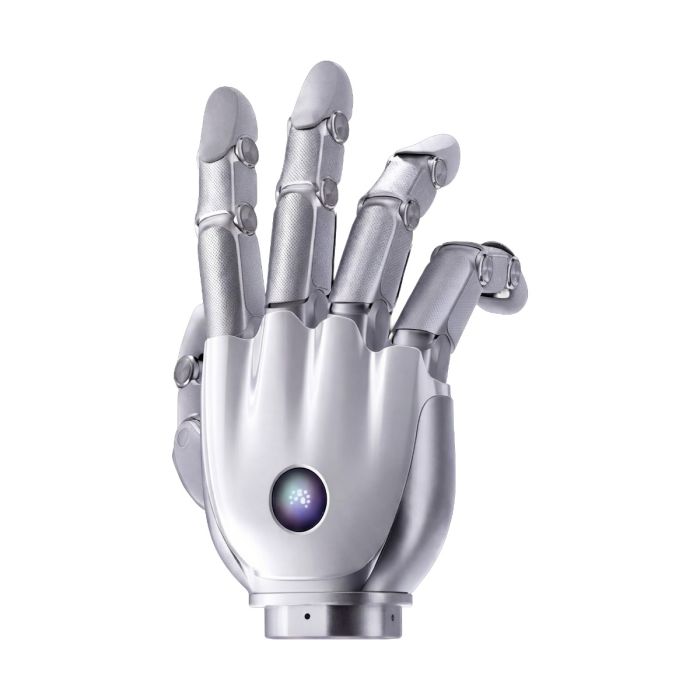
BrainCo Revo 3-21 Touch Robot Hand
In stock
- BRAND:
- BRAINCO
- MODEL:
- REVO 3-21 TOUCH
- ORIGIN:
- China
- Warranty:
- 12 MONTHS
- AVAILABILITY:
- SUBJECT TO AVAILABILITY
- SKU:
- BrainCo-Revo-3-Touch
Picking up a pen in a dark room is a matter of feel rather than sight, and robots have long struggled with exactly that. The BrainCo Revo 3-21 Touch Robot Hand is an answer aimed at this problem: a multi-jointed hand whose palm carries a piezoresistive sensing array, so the controller receives a record of contact as well as a record of motion.
Robots Middle East supplies the BrainCo Revo 3-21 Touch Robot Hand to customers across the Middle East. Our team prepares the quotation, arranges delivery and customs with it, and supports the hand once it is in service.
Background
BrainCo and the Revo line
BrainCo is the maker of the Revo family of dexterous hands. Revo 3 is the third generation of the line, and the manufacturer reports that it was launched on 10 April 2026. Earlier generations remain part of the range we supply, among them the BrainCo Revo 1 Intelligent Dexterous Bionic Hand and the Brainco Revo 2 Touch Biomimetic Dexterous Right Hand (XTR), which makes it straightforward for a buyer to compare generations before choosing.
The Revo 3 platform is sold in several versions. The sources name the Revo 3 U21, the U21F, the U21T and the U21VT. The hand described on this page is the Touch version; we match it to the U21T, the version for which the sources publish a full-palm tactile array. You can browse the whole generation in our BrainCo Revo 3 category.
Positioning and key technology
The central idea of the Revo 3 is a hand that is both direct-driven and backdrivable. In plain terms, the joints are driven without an intermediate transmission that would resist being moved from outside, so that the hand can yield when it meets an unexpected force. For anyone working on contact-rich tasks, that compliance is often as valuable as raw precision.
The hand offers 21 degrees of freedom, distributed as four degrees for each of the four fingers and five for the thumb. The manufacturer reports full marks on the Kapandji opposition test and coverage of 33 grasp types from the Feix GRASP taxonomy. The Touch version adds the sensing layer: a full-palm piezoresistive array with 451 points. All of these figures come from a single published source and are to be confirmed against the datasheet at quotation.
Technical Specifications
| Specification | Value |
|---|---|
| Degrees of freedom | 21, direct-driven and backdrivable |
| DoF distribution | Four fingers × 4 DoF, thumb × 5 DoF |
| Hand dimensions | 216 × 108 × 50 mm |
| Maximum current | 10 A (24 V) |
| Motion capability | Full score on the Kapandji opposition test; 33 grasp types (Feix GRASP taxonomy) |
| Communication interfaces | EtherCAT / CAN FD / RS-485 |
| Onboard sensors | IMU (mainboard), temperature (mainboard) |
| Tactile type (Touch version) | Full-palm piezoresistive array |
| Tactile array points (Touch version) | 451 (piezoresistive) |
| Durability | Rated for over 1,000,000 joint flex cycles |
| Software | C/C++ and Python SDKs for Linux and Windows |
| Recommended power supply | Stable 24 V DC, rated at least 100 W |
| Weight | Not published by the manufacturer |
| Ingress protection rating | Not published by the manufacturer |
| Operating temperature range | Not published by the manufacturer |
| Finger material | Not published by the manufacturer |
| Noise level | Not published by the manufacturer |
| What is in the box | Not published by the manufacturer |
Specifications as published; confirmed against the datasheet at quotation. Where the manufacturer has not published a value, such as weight or the ingress protection rating, it is confirmed with the manufacturer when you request a quotation.
What makes the Touch version different from the other Revo 3 versions?
The Revo 3 versions share the same mechanical core: 21 degrees of freedom, the same dimensions, the same maximum current, the same three communication interfaces and the same grasp coverage. What separates them is the sensing. According to the published specification, the Touch version carries a full-palm piezoresistive array of 451 points, a feature the sources attach to the U21T alone.
That matters because a hand without tactile feedback can only infer a grip from joint position and current. With an array across the palm, the controller can see where an object rests, whether it is shifting, and whether contact is even. Teams developing learned manipulation policies, or validating a grasp before lifting, will generally value this data. If your application needs only motion and no contact map, the BrainCo Revo 3-21 Basic Robot Hand may be the more economical match for the task.
How does the Touch version compare with the V-Touch?
The sources also name a U21VT version, which our catalogue lists as the BrainCo Revo 3-21 V-Touch Robot Hand. The fact sheet for this page does not carry its tactile or visual specification, so we will not state figures for it here. What can be said is that the Touch version is the one whose palm array is documented, at 451 points. Buyers weighing the two should ask us for the V-Touch datasheet and compare the sensing in full at quotation.
Who is the BrainCo Revo 3-21 Touch Robot Hand for?
Research laboratories are the clearest segment. Groups working on dexterous manipulation, imitation learning or grasp planning need a hand that is open to their own code, and the C/C++ and Python SDKs for Linux and Windows suit that way of working. The three communication interfaces, EtherCAT, CAN FD and RS-485, let it join a range of control architectures.
Industrial automation teams form the second segment, in particular those assessing tasks in which parts vary in shape or in which the position of a grasp must be verified. Developers of humanoid and other advanced manipulation platforms are the third, since a hand of this size and articulation is a natural end-effector for them. Customers who do not need palm sensing should look at the Basic version, while those who want the broader sensing option should review the V-Touch.
What is the BrainCo Revo 3-21 Touch Robot Hand used for?
- Dexterous manipulation research: studying in-hand movement and grasp strategy with a hand that covers 33 published grasp types.
- Tactile learning: collecting palm contact data from the 451-point array to train and test manipulation models.
- Industrial handling trials: evaluating whether a flexible hand can take on parts that fixed grippers handle poorly.
- Humanoid end-effector development: fitting a 21-degree-of-freedom hand to a humanoid or dual-arm research platform.
- Teleoperation and demonstration: recording human-guided grasps and replaying them with contact feedback.
- Teaching and prototyping: giving advanced robotics courses a hand that can be programmed in Python or C/C++.
Pricing and Availability
We do not publish prices on this page. The call to action is a quotation: tell Robots Middle East about your application and quantity, and we will respond with a formal offer. Delivery, customs and support are arranged with the quotation, and the unpublished specifications noted above are confirmed at the same time. Everything else we can share about this hand is available on this page.
Frequently Asked Questions
How many degrees of freedom does the hand have?
It has 21, reported as direct-driven and backdrivable. The four fingers have 4 each and the thumb has 5.
What does the tactile array cover?
Per the published specification, the Touch version has a full-palm piezoresistive array of 451 points. The fingertip sensing is not described in the fact sheet, so it is confirmed at quotation.
Which communication interfaces are supported?
The published interfaces are EtherCAT, CAN FD and RS-485. They are listed for all Revo 3 versions.
What power supply does it need?
The manufacturer recommends a stable 24 V DC supply rated at no less than 100 W, to reduce the risk of voltage drop. The maximum current is published as 10 A at 24 V.
Which software is available?
The manufacturer provides C/C++ and Python SDKs that are compatible with Linux and Windows.
What is the weight and ingress protection rating?
The manufacturer has not published either value, nor the operating temperature range or the contents of the box. They are confirmed at quotation.
Where can I buy the BrainCo Revo 3-21 Touch Robot Hand and what does it cost?
You can buy it from Robots Middle East, which supplies it across the Middle East. We do not list a price here; send us a quotation request and we will reply with an offer that includes delivery and support arrangements.
Summary
A hand that moves well but cannot feel is only half an instrument. The BrainCo Revo 3-21 Touch Robot Hand combines 21 backdrivable degrees of freedom, 33 reported grasp types and a 451-point palm array, with open SDKs and industrial interfaces, all as published by a single source and subject to confirmation against the datasheet. For laboratories, automation teams and humanoid developers who need contact information as well as motion, Robots Middle East can quote, deliver and support it, and this page is the starting point.