BrainCo Revo 3-21 V-Touch Robot Hand
In stock
- BRAND:
- BRAINCO
- MODEL:
- REVO 3-21 V-TOUCH
- ORIGIN:
- China
- Warranty:
- 12 MONTHS
- AVAILABILITY:
- SUBJECT TO AVAILABILITY
- SKU:
- BrainCo-Revo-3-V-Touch
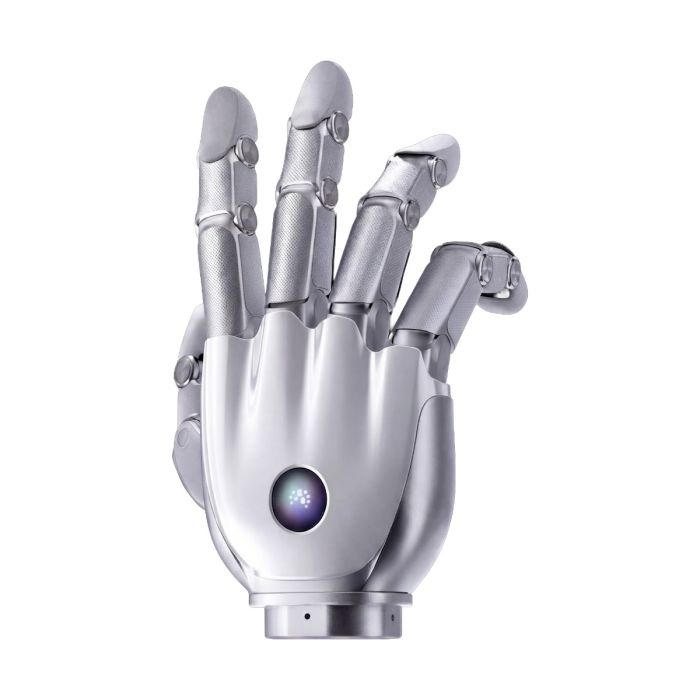
Anyone who has watched a robot arm fumble an egg, a connector or a cable knows that the wrist is rarely the problem: the fingers are. The BrainCo Revo 3-21 V-Touch Robot Hand is a response to that weakness, a biomimetic dexterous hand that, according to the published specification, pairs direct-driven, backdrivable joints with touch sensing in both the palm and the fingertips.
Robots Middle East supplies this hand to customers across the Middle East. We prepare the quotation, arrange delivery and customs with it, and support the hand after it arrives, so a single point of contact covers the purchase from enquiry to commissioning.
Background
The company and its lineage
BrainCo is reported to be a Hangzhou-based brain-computer interface company, sometimes grouped among China's so-called "Six Little Dragons". The Revo 3 is described by the manufacturer's material as its third-generation robot dexterous hand. Earlier generations of the family, including the Revo 1 and Revo 2 hands, remain listed in our catalogue for buyers who want to compare generations, such as the Brainco Revo 2 Touch Biomimetic Dexterous Right Hand (XTR).
The Revo 3 is sold in several versions, named in the sources as Revo 3 U21, U21F, U21T and U21VT. This page concerns the V-Touch version, and every figure below belongs to that version alone. We have deliberately not borrowed values from its siblings.
Positioning and key technology
The manufacturer positions the Revo 3 for industrial automation, scientific research and advanced robotics manipulation. Three features define the V-Touch version in the published specification. The first is a total of 21 degrees of freedom, all direct-driven and backdrivable. The second is a palm piezoresistive array combined with fingertip vision-tactile sensing. The third is a choice of EtherCAT, CAN FD and RS-485 communication, with a stated communication frequency of 500 Hz.
Direct drive matters because a backdrivable joint can yield to external force instead of resisting it rigidly, which is a useful property when a hand works close to people, fragile objects or imperfectly positioned parts. The vision-tactile fingertips add a second kind of information: rather than only a pressure reading, the controller receives an image-based picture of contact.
Technical Specifications
| Specification | Value (V-Touch version) |
|---|---|
| Total degrees of freedom | 21 (direct-driven and backdrivable) |
| DoF distribution | Four fingers × 4 DoF, thumb × 5 DoF |
| Hand dimensions | 216 × 108 × 50 mm |
| Supply voltage | 16–85 V |
| Max current | 10 A (24 V) |
| Max active grip force | ≥100 N |
| Max fingertip pinch force | ≥25 N |
| Total hand payload | 20 kg |
| Four-finger payload | 5 kg |
| Repeatability | 0.1° |
| Joint open/close time | 0.33 s |
| Max grasping diameter | 150 mm |
| Communication interface | EtherCAT / CAN FD / RS-485 |
| Communication frequency | 500 Hz |
| Onboard sensors | IMU (mainboard), temperature (mainboard) |
| Tactile type | Palm piezoresistive array + fingertip vision-tactile |
| Tactile points | 336 points (piezoresistive) + 2000 markers (vision-tactile) |
| Motion capability | Full score on the Kapandji opposition test; covers 33 grasp types (Feix GRASP taxonomy) |
| Durability | Rated for over 1,000,000 joint flex cycles |
| Software | Cross-platform C/C++ and Python SDKs for Linux and Windows |
| Weight, IP rating, operating temperature range, noise level, fingertip camera specification | Not published by the manufacturer; confirmed at quotation |
Specifications as published by a single source; they are confirmed against the manufacturer's datasheet at quotation.
What makes the V-Touch version different from the other Revo 3 versions?
The sources name four Revo 3 versions: U21, U21F, U21T and U21VT. The name of this one, V-Touch, points to its distinguishing feature, which is fingertip vision-tactile sensing used together with the palm piezoresistive array. The published specification gives this version 336 piezoresistive points in the palm and 2000 markers in the vision-tactile fingertips.
In practical terms, the palm array tells a controller where and how firmly an object rests against the hand, while the fingertip system is intended to describe contact at the point of touch in more detail. Together they let software judge whether a grasp is holding, slipping or still being formed. The manufacturer has not published the specification of the fingertip cameras, so teams planning vision-based algorithms should ask for it when requesting a quotation.
If your work does not need vision-based touch, the BrainCo Revo 3-21 Basic Robot Hand and the BrainCo Revo 3-21 Touch Robot Hand are the natural pages to compare. We recommend confirming exactly which sensing each one carries before deciding.
How capable is the hand at grasping and manipulation?
Per the published specification, the hand scores fully on the Kapandji opposition test, a clinical measure of how well the thumb can reach the other fingers, and covers 33 grasp types from the Feix GRASP taxonomy. The thumb has 5 degrees of freedom and each of the four fingers has 4, which is the structure behind that range.
The stated load figures are a total hand payload of 20 kg and a four-finger payload of 5 kg. Maximum active grip force is given as at least 100 N and fingertip pinch force as at least 25 N, with a maximum grasping diameter of 150 mm. A repeatability of 0.1° and a joint open/close time of 0.33 s complete the picture of a hand intended for repeatable work. The manufacturer also rates the joints for over 1,000,000 flex cycles, which is relevant to anyone planning long test campaigns.
As for power, the manufacturer recommends a stable 24 V DC supply rated for at least 100 W, to reduce the risk of voltage drop. The published supply range for this version is 16–85 V.
Who is the BrainCo Revo 3-21 V-Touch Robot Hand for?
Research laboratories working on embodied AI, tactile learning and in-hand manipulation are the clearest fit, since the tactile data and the open software interfaces are what such work depends on. Developers of humanoid robots, who need a hand with a full-size thumb and a broad grasp repertoire, form a second group.
Industrial integrators evaluating precision handling of delicate or irregular items will also find the feature set relevant, particularly where EtherCAT or CAN FD is already in use on the cell. Universities equipping teaching and demonstration laboratories may value the Linux and Windows SDKs in C/C++ and Python.
Buyers who simply need a capable multi-fingered hand without touch sensing, or with a lighter sensing package, should look at the Basic or Touch pages instead. Our team can advise on which version suits a project once the task is described.
What is the BrainCo Revo 3-21 V-Touch Robot Hand used for?
- Embodied AI research: collecting palm and fingertip tactile data to train and test manipulation policies.
- Humanoid robot end-effector: giving a humanoid platform a full-size hand with a five-degree-of-freedom thumb.
- Precision automation: handling objects that need adjusting contact rather than a simple clamp.
- Grasp-taxonomy studies: exploring the 33 grasp types the manufacturer reports the hand covers.
- Teleoperation development: testing remote control schemes over a 500 Hz communication link.
- Teaching and demonstration: showing students how tactile feedback changes robotic manipulation, using the Python and C/C++ SDKs.
Pricing and Availability
Robots Middle East does not publish prices for this hand. The call to action is to request a quotation, which reflects your configuration, quantity and destination. Delivery, customs and support are arranged together with the quotation, so there are no separate arrangements to chase. Weight, IP rating, operating temperature range and the contents of the box have not been published by the manufacturer, and we confirm them at that stage. Everything you need to begin the request is available on this page.
Frequently Asked Questions
How many degrees of freedom does the hand have?
The published specification gives 21 in total, direct-driven and backdrivable. The four fingers have 4 each and the thumb has 5.
Which communication interfaces are supported?
The specification lists EtherCAT, CAN FD and RS-485, with a communication frequency of 500 Hz.
What touch sensing does it carry?
It combines a palm piezoresistive array of 336 points with fingertip vision-tactile sensing of 2000 markers, as reported in the specification. The fingertip camera specification is not published.
Which software is available for development?
The manufacturer describes complete cross-platform C/C++ and Python SDKs, compatible with Linux and Windows.
What power supply is recommended?
A stable 24 V DC supply rated for at least 100 W is recommended, to reduce voltage drop. The supply range published for this version is 16–85 V.
Is the weight or ingress protection rating known?
The manufacturer has not published the weight or an IP rating. Both are confirmed at quotation, and we recommend verifying them before planning wet or dusty environments.
Where can I buy the BrainCo Revo 3-21 V-Touch Robot Hand and what does it cost?
It is supplied by Robots Middle East, which quotes, delivers and supports it across the Middle East. No price is listed; please request a quotation and we will respond with terms for your configuration.
Summary
A hand that only opens and closes leaves the hardest part of manipulation to chance. The BrainCo Revo 3-21 V-Touch Robot Hand is built around the stage in between, with 21 backdrivable degrees of freedom, a palm array and vision-tactile fingertips that, as reported, let software see how contact develops. Its published figures, including 20 kg total payload, 0.1° repeatability and three industrial communication interfaces, are to be confirmed against the datasheet, and several specifications remain unpublished. For quotation, delivery and support from Robots Middle East, this page is the starting point.