
BrainCo Revo 3-21 Basic Robot Hand
In stock
- BRAND:
- BRAINCO
- MODEL:
- REVO 3-21 BASIC
- ORIGIN:
- China
- Warranty:
- 12 MONTHS
- AVAILABILITY:
- SUBJECT TO AVAILABILITY
- SKU:
- BrainCo-Revo-3
BrainCo Revo 3-21 Basic Robot Hand
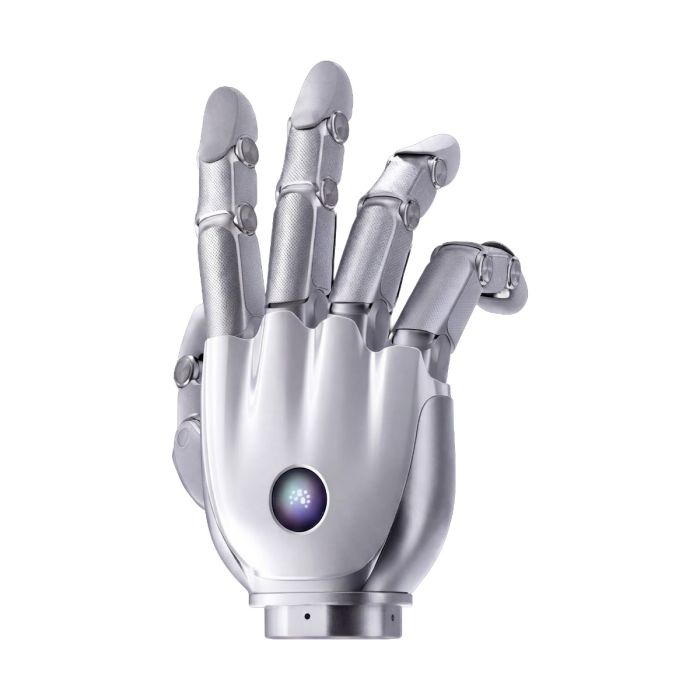
Ask anyone who has lost the use of a thumb what a hand is, and the answer is rarely "a way to squeeze". The thumb is what turns a clamp into a hand, and the BrainCo Revo 3-21 Basic Robot Hand takes that lesson seriously: five of its degrees of freedom belong to the thumb alone, with four more in each of the other four fingers. It is a hand for teams who want to command a pinch, a wrap or a slow release, rather than a single open-and-close action.
Robots Middle East is the seller of this hand. We quote it for customers across the Middle East, arrange its supply to the project site, and remain the point of contact for delivery and support once the hand is in your laboratory or on your production line.
Background
BrainCo and the Revo lineage
BrainCo was founded in 2015 and builds robotic products that draw on the company's work in human-machine interfaces. The Revo name has appeared on several hands before this one. Our catalogue lists the BrainCo Revo 1 Intelligent Dexterous Bionic Hand and a number of Revo 2 models, including the BrainCo Revo 2 Basic Right Dexterous Bionic Hand (XRR), and the Revo 3 generation sits beside them as a separate family.
The Revo 3 family is documented under several version names: Revo 3 U21, U21F, U21T and U21VT in the manufacturer's material, and Basic, Touch and Vision in reseller listings. This page concerns the Basic version. All Revo 3 hands can be browsed in the BrainCo Revo 3 category.
A biomimetic hand built around direct drive
The Revo 3 is a biomimetic dexterous hand designed for industrial automation, scientific research and advanced robotics manipulation. Its architecture is simple to state and demanding to build: 21 fully active, independently driven degrees of freedom, with five in the thumb and four in each of the index, middle, ring and pinky fingers. Every one of those joints has its own motor, so no finger is slaved to another through a shared tendon or linkage.
The joints are direct-driven and backdrivable. In practical terms, this gives rapid response and high control density across all finger segments, and it means an external push on a finger can be sensed through the mechanism rather than blocked by it. For researchers working on compliant manipulation, that property is often the reason to choose a hand of this kind.
Technical Specifications
The manufacturer's table covers the Revo 3 U21 and applies to all four of its U21-series models. Reseller listings for the Basic version carry some different figures, and the two are therefore kept in separate columns.
| Specification | Revo 3 U21 (manufacturer table) | Revo 3 Basic (reseller listing) |
|---|---|---|
| Degrees of freedom | 21 (five in the thumb, four in each finger) | 21 (five in the thumb, four in each finger) |
| Dimensions | 216 × 108 × 50 mm | 215 × 105 × 50 mm |
| Supply voltage | 16–85 V | 12–80 V |
| Max current | 10 A (24 V) | Not listed |
| Max active grip force | ≥100 N | >70 N |
| Max fingertip pinch force | ≥25 N | Not listed |
| Total hand payload | 20 kg | Not listed |
| Four-finger payload | 5 kg | Not listed |
| Repeatability | 0.1° | Not listed |
| Joint open/close time | 0.33 s | Not listed |
| Max grasping diameter | 150 mm | Not listed |
| Communication interfaces | EtherCAT / CAN FD / RS-485 | Not listed |
| Communication frequency | 500 Hz | Not listed |
| Onboard sensors | IMU (mainboard), temperature (mainboard) | Not listed |
| Tactile sensors | Not listed | Not included |
| Control modes | Not listed | Position / MIT Force-Position / Admittance / Zero-Torque |
| Rated service life | Over 1,000,000 joint flex cycles | Over 1,000,000 joint flex cycles |
| Software | C/C++ and Python SDKs for Linux and Windows | C/C++ and Python SDKs for Linux and Windows |
Specifications as published by the manufacturer; confirmed against the datasheet at quotation.
The manufacturer has not published the weight, the box contents, the IP rating, the operating temperature range or the power consumption; they are confirmed at quotation.
What makes the Revo 3 Basic different from a two-jaw gripper?
A parallel gripper is excellent at one job: closing on a part of known size. It cannot reorient an object, cannot form a pinch between thumb and fingertip, and cannot wrap around an irregular shape. A hand with 21 independently driven joints can do all three, because each joint group can be commanded separately. The price of that freedom is a more demanding integration, since the controller must now coordinate many axes instead of one.
The Basic version offers the control modes to do this: position, MIT force-position, admittance and zero-torque. Position control suits repeatable, scripted motions. Force-position and admittance modes suit work in which the hand must yield to contact. Zero-torque mode lets a person move the fingers by hand, which is useful when a motion is to be demonstrated rather than programmed.
The hand also comes with cross-platform C/C++ and Python SDKs for Linux and Windows. A team that already runs its research code in Python, or its real-time code in C++, can therefore begin without writing a driver from scratch.
What does the Basic version leave out?
The Basic version is listed without tactile sensors. Its fingers move precisely and can be commanded in force-aware modes, but it does not report touch through fingertip sensing. For many tasks, including motion research, teleoperation and structured grasping with vision supplied elsewhere, that is a sensible place to begin and a more modest investment of integration effort.
Teams who need touch feedback in the hand itself should look at the BrainCo Revo 3-21 Touch Robot Hand, or at the BrainCo Revo 3-21 V-Touch Robot Hand where vision is also wanted. We can help compare them against your application when preparing a quotation.
Who is the BrainCo Revo 3-21 Basic Robot Hand for?
Research laboratories are the clearest audience. A hand with this many active joints is a platform for studying grasping, in-hand manipulation, imitation learning and compliant control, and the backdrivable joints make it well suited to experiments in which contact is part of the data.
Automation engineers and integrators form the second group. Where a task involves varied parts, small tools or objects that a fixed jaw cannot hold, a multi-finger hand widens what a robot arm can be asked to do. The communication options, with EtherCAT, CAN FD and RS-485 listed in the manufacturer's table, fit the buses commonly found in industrial cells.
Developers of humanoid and teleoperated systems make up the third. A hand that follows an operator's finger motions closely, and that can be moved freely in zero-torque mode, is a natural end effector for such work. Buyers who already know they need fingertip touch sensing are better served by the Touch version than by this one.
What is the BrainCo Revo 3-21 Basic Robot Hand used for?
- Dexterous manipulation research: studying how multi-finger hands grasp, reposition and release objects.
- Industrial automation: handling varied or awkward parts that a two-jaw gripper cannot hold reliably.
- Teleoperation: reproducing an operator's hand movements on a remote arm.
- Humanoid robot development: giving a humanoid platform a hand with a full set of thumb and finger joints.
- Compliant and force-aware control: testing admittance and force-position strategies on backdrivable joints.
- Teaching and demonstration: using zero-torque mode to guide the fingers by hand and record the motion.
Pricing and Availability
We do not publish a price for this hand. Quotation is the next step: send us your application, the arm or platform you intend to mount it on and the quantity you need, and Robots Middle East will prepare an offer. Delivery, customs and support are arranged with the quotation. Everything you need to begin that request is available on this page.
Frequently Asked Questions
How many degrees of freedom does the Revo 3 Basic have?
It has 21 fully active, independently driven degrees of freedom: five in the thumb and four in each of the index, middle, ring and pinky fingers.
Does the Basic version include tactile sensors?
No. Tactile sensors are not included in the Basic version. The Touch and V-Touch versions are the ones to consider if fingertip sensing is required.
Which control modes are available?
The Basic version lists position, MIT force-position, admittance and zero-torque control modes.
Which software can I use to control it?
The hand is supported by C/C++ and Python SDKs that work on both Linux and Windows.
Why do the grip force and voltage figures differ between sources?
The manufacturer's table covers the Revo 3 U21 and gives a grip force of at least 100 N and a supply voltage of 16–85 V. A reseller listing for the Basic version gives more than 70 N and 12–80 V. We confirm the figures for your version when quoting.
How long is the hand rated to last?
It is rated for over 1,000,000 joint flex cycles.
Where can I buy the BrainCo Revo 3-21 Basic Robot Hand and what does it cost?
Robots Middle East supplies it to customers across the Middle East. The cost depends on quantity, delivery and support requirements, so please request a quotation and we will respond with an offer for your project.
Summary
The thumb is what makes a hand, and the BrainCo Revo 3-21 Basic Robot Hand gives it, and every finger, its own motors, with direct-driven, backdrivable joints, a choice of control modes and C/C++ and Python SDKs. It omits tactile sensing by design, and its sibling versions cover that need. For laboratories, integrators and humanoid developers in the Middle East who want to move beyond a gripper, this page is the starting point.