
Deep Robotics Lite3 Basic Quadruped Robot Dog
In stock
- BRAND:
- DEEP ROBOTICS
- PART #:
- Lite3
- ORIGIN:
- China
- AVAILABILITY:
- ALLOW 2-4 WEEKS FOR DELIVERY
- SKU:
- Deep-Robotics-Lite3-Basic
Deep Robotics Lite3 Basic Quadruped Robot Dog
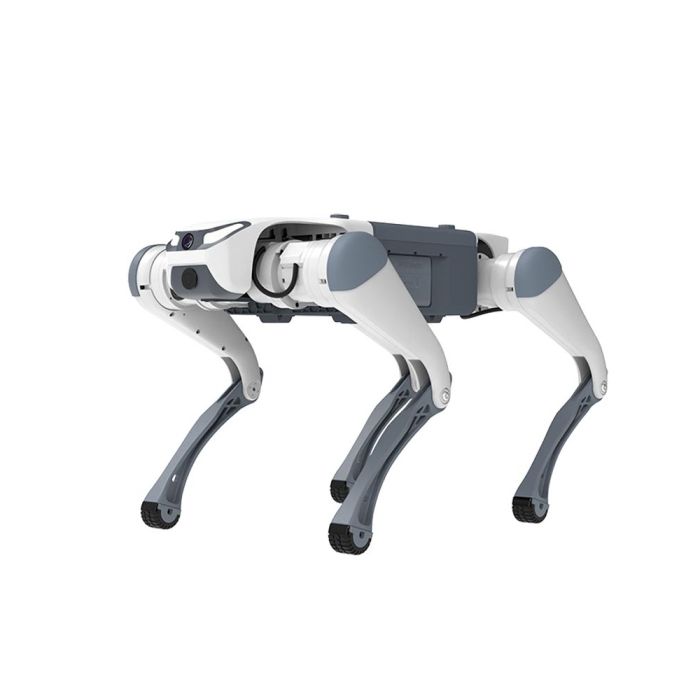
Some machines are best understood by what they add; the Lite3 Basic is easier to understand by what it leaves out. Its hardware interfaces are N/A, and the NVIDIA perception host that DEEP Robotics fits to the Pro and LiDAR versions is not part of its configuration. That restraint is deliberate. The Deep Robotics Lite3 Basic Quadruped Robot Dog gives a laboratory the part of legged robotics that has to be mastered first: a body that walks, climbs and keeps its balance, governed by an open software stack that students and researchers can study and rewrite. Every other member of the Lite3 family builds on that foundation. The Basic hands it over without anything layered on top.
Robots Middle East supplies the Deep Robotics Lite3 Basic Quadruped Robot Dog to universities, schools, research centres and engineering teams across the Middle East. Robots Middle East prepares each quotation, arranges delivery to the customer's site and remains the point of contact for technical questions and support once the robot is in use. Institutions comparing configurations can discuss their teaching or research programme with the team before committing to a version.
Background
DEEP Robotics and the Lite3 platform
DEEP Robotics develops legged robots that range from compact research platforms to industrial quadrupeds built for inspection work. The Lite3 is the compact end of that range. The manufacturer designed it as a high-performance quadruped for academic research, reinforcement learning experiments and robotics education. It sits within the wider group of Standard Quadrupeds, robots that walk on four legs rather than roll on wheels or tracks and so can negotiate steps, slopes and uneven floors that defeat most mobile bases. The Lite3 family is offered in several versions: Basic, Basic AI, Venture, Pro and LiDAR. An overview of the platform as a whole is available on the Deep Robotics Lite3 Academic & Research Quadruped Robot Dog page.
The motion host and an open software stack
Locomotion on the Lite3 is handled by a motion host built on an RK3588 ARM-architecture processor. The robot runs Ubuntu 20.04 and is compatible with both ROS1 (Noetic) and ROS2 (Foxy). That matters in a teaching environment, because a course can introduce the established ROS1 tooling and move on to ROS2 without changing hardware. DEEP Robotics provides open SDK and API access, so developers and researchers can carry out secondary motion and perception development on either ROS platform. The Lite3 delivers enhanced joint torque, up 50%, together with faster response bandwidth and precise motion control. An adaptable modular design supports a wide range of additional functional modules, so the robot can be extended as a project grows.
Technical Specifications
| Specification | Value |
|---|---|
| Configuration | Basic |
| Positioning | Entry-level robotics education and motion control learning |
| Standing dimensions (L × W × H) | 610 × 370 × 406 mm |
| Weight | 12 kg |
| Payload capacity | 5 kg |
| Maximum slope | 40° |
| Obstacle clearance | 18 cm |
| Continuous operation | 1.5 – 2 hours |
| Maximum range | 5 km |
| Perception features | Front/rear obstacle stop; visual following |
| Hardware interfaces | N/A |
| Motion host processor | RK3588 ARM-architecture processor |
| Operating system | Ubuntu 20.04 |
| ROS compatibility | ROS1 (Noetic) and ROS2 (Foxy) |
| Development access | Open SDK and API for secondary motion and perception development |
| Joint torque | Enhanced, up 50% |
| Protection | Overtemperature protection: stops and lies down if motors overheat |
Specifications are as published by the manufacturer and are confirmed against the datasheet at quotation.
DEEP Robotics has not published the maximum speed, battery capacity, charging time, IP rating, operating temperature range, degrees of freedom, wireless connectivity or the contents of the box for the Lite3 Basic; Robots Middle East confirms each of these at quotation.
What separates the Lite3 Basic from the Pro and LiDAR versions?
The clearest dividing line is computing. All Lite3 versions rely on the RK3588 motion host, but DEEP Robotics adds an NVIDIA Jetson Xavier NX as a perception host on the Pro and LiDAR versions. That second computer is where demanding vision and mapping work runs. The Basic does without it, and its own perception is limited to two practical functions: a front and rear obstacle stop, and visual following.
The Basic's hardware interfaces are N/A, whereas higher configurations are intended to carry additional sensors and payloads. For a course on gait, balance and motion control this is rarely a limitation; the lessons concern how the legs move, not how the robot builds a map. For a research group whose work depends on onboard perception, the Deep Robotics Lite3 Pro Quadruped Robot Dog or the Deep Robotics Lite3 LIDAR Quadruped Robot Dog is the more logical choice. For the Basic AI and Venture versions, Robots Middle East can explain how each compares with the Basic.
Can the Lite3 Basic support reinforcement learning research?
The Lite3 platform was designed with reinforcement learning experiments in mind, and the Basic shares the elements that such work depends on: the open SDK and API, Ubuntu 20.04, and compatibility with ROS1 and ROS2. A learned locomotion policy is, at heart, a motion controller, and the Basic's positioning around motion control learning suits exactly that stage of research.
Physical trials of new policies are also where hardware is most at risk. The Lite3's overtemperature protection stops the robot and lies it down if the motors overheat, which gives students a measure of safety when an experimental controller drives the joints harder than intended. Where a research programme later combines learned locomotion with onboard vision, the perception host of the Pro or LiDAR versions becomes relevant; for locomotion-first work, the Basic covers the essentials.
Who is the Deep Robotics Lite3 Basic Quadruped Robot Dog for?
The Basic is aimed first at university departments that teach robotics, mechatronics or control engineering and want students to work with a real legged machine rather than a simulation alone. Its 12 kg weight means it can be carried between a store room and a teaching laboratory, and its open ROS environment fits naturally into existing coursework.
Research groups focused on locomotion, balance and learned gait control form a second audience, particularly where the budget is better spent on several robots than on one heavily equipped unit. Technical colleges, innovation centres and STEM programmes across the region are a third, using the robot to demonstrate what legged robotics can do and to introduce students to ROS.
Buyers whose projects need more than the Basic offers should look further up the line. Teams planning perception, mapping or autonomous navigation work will be better served by the Pro or LiDAR versions, which carry the Jetson Xavier NX perception host. Those exploring a mid-range configuration can review the Deep Robotics Lite3 Venture Quadruped Robot Dog and discuss its fit with Robots Middle East.
What is the Deep Robotics Lite3 Basic Quadruped Robot Dog used for?
- Motion control teaching — giving students a working quadruped on which to study gait, balance and joint control.
- Locomotion experiments — testing walking behaviour on slopes of up to 40° and over obstacles of up to 18 cm.
- ROS training — teaching ROS1 (Noetic) and ROS2 (Foxy) on real hardware running Ubuntu 20.04.
- Reinforcement learning trials — deploying learned locomotion policies through the open SDK and API.
- Human–robot interaction demonstrations — using visual following to show how a robot responds to a person.
- Outreach and open days — presenting legged robotics to prospective students, visitors and partners.
Pricing and Availability
Robots Middle East prices the Lite3 Basic by quotation, so that each offer reflects the configuration, quantity and destination the institution actually requires. Delivery, customs clearance and after-sales support are arranged together with the quotation. Where a laboratory is weighing the Basic against another Lite3 version, the quotation can cover both so that the comparison rests on the same terms. To begin, use the quotation request available on this page.
Frequently Asked Questions
Which operating system and ROS versions does the Lite3 Basic support?
The Lite3 runs Ubuntu 20.04 and is compatible with both ROS1 (Noetic) and ROS2 (Foxy). Open SDK and API access allows secondary development on either platform.
How much can the Lite3 Basic carry?
The Basic has a payload capacity of 5 kg. Because its hardware interfaces are N/A, any plan to mount equipment should be discussed with Robots Middle East before ordering.
How long does the Lite3 Basic operate between charges?
The Basic offers 1.5 – 2 hours of continuous operation.
Does the Lite3 Basic avoid obstacles?
The Basic provides a front and rear obstacle stop and a visual following function. More advanced perception is the role of the Pro and LiDAR versions, which add an NVIDIA Jetson Xavier NX perception host.
What happens if the motors overheat?
The Lite3 has overtemperature protection: if the motors overheat, the robot automatically stops and lies down. This protects the hardware during demanding experiments.
Can the Lite3 Basic be extended later?
The Lite3 platform has an adaptable modular design that supports a wide range of additional functional modules. Robots Middle East can advise which modules suit the Basic configuration for a given project.
Where can I buy the Deep Robotics Lite3 Basic Quadruped Robot Dog and what does it cost?
Robots Middle East supplies the Lite3 Basic across the Middle East and prices it by quotation. Request a quote on this page and the team will respond with an offer covering delivery and support.
Summary
The Lite3 Basic is defined as much by its restraint as by its abilities. It omits the perception computer and expansion interfaces of the higher versions and concentrates on what a student or researcher must understand first: how a four-legged machine walks, climbs, balances and protects itself. A 12 kg body, a 5 kg payload, an RK3588 motion host, Ubuntu 20.04, ROS1 and ROS2 compatibility and an open SDK make it a sound foundation for teaching and locomotion research, with the Pro, LiDAR and Venture versions available when a programme outgrows it. Robots Middle East quotes, delivers and supports the robot throughout the region. For any institution ready to put a real legged robot in front of its students, this page is the starting point.
Specifications
General
Physical
Performance
Software
Battery + Power
What's included
Downloads
Related Products
Out of stock