
Deep Robotics Lite3 Venture Quadruped Robot Dog
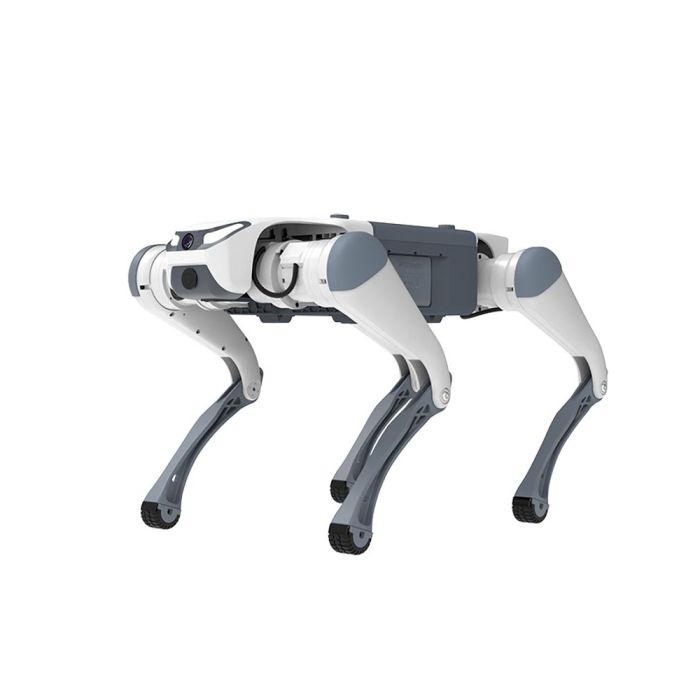
In stock
- BRAND:
- DEEP ROBOTICS
- PART #:
- Lite3 Venture
- ORIGIN:
- China
- AVAILABILITY:
- ALLOW 2-4 WEEKS FOR DELIVERY
- SKU:
- Deep-Robotics-Lite3-Venture
Deep Robotics Lite3 Venture Quadruped Robot Dog
In most legged-robot research, the walking is not the experiment. The gait is a given, and the real question sits on top of it: a new perception model, a following behaviour, or a sensor that must travel across a courtyard without being shaken loose. The Deep Robotics Lite3 Venture Quadruped Robot Dog is best understood in those terms. It is a walking test bench, compact enough to carry between the laboratory and the car park, with the connections and open software a team needs to place its own work on a quadruped whose locomotion is already solved.
Robots Middle East sells the Lite3 Venture to universities, research institutes, technical colleges and engineering teams across the Middle East. Robots Middle East prepares each quotation, arranges delivery to the customer's site and remains the point of contact for support once the robot is in service. A laboratory therefore deals with one regional partner from the first enquiry to the final report of the project.
Background
DEEP Robotics and the Lite3 family
DEEP Robotics develops legged robots, from compact platforms for teaching and research to heavier machines designed for industrial inspection. The Lite3 belongs to the company's lighter tier, collected on our Lite Series page, and forms part of the wider Standard Quadrupeds category. Quadrupeds of this class are chosen where wheels struggle: steps, kerbs, loose ground and the cluttered floors of a working laboratory. In an academic setting they also give students something tangible, a robot that responds visibly to the code they write.
The Lite3 is built around an adaptable modular design that supports a wide range of additional functional modules. The family delivers enhanced joint torque (up 50%), faster response bandwidth and precise motion control, and its motion host runs on an RK3588 ARM-architecture processor. For the people who programme it, the most important point is the software: the Lite3 supports Ubuntu 20.04 and works with both ROS1 (Noetic) and ROS2 (Foxy).
Where the Venture sits in the range
The Lite3 is offered in four versions: Basic, Venture, Pro and LIDAR. The Venture is the extended version with additional I/O interfaces. It carries two Ethernet ports and an External Power Input (24V/12V/5V), and its perception features are front and rear obstacle stop and visual following. DEEP Robotics positions it for AI programming, robotics laboratories and intermediate research, the stage at which a team has outgrown a robot that simply walks but does not yet need the dedicated perception computer fitted to the Pro and LIDAR versions.
Technical Specifications
| Specification | Value |
|---|---|
| Standing dimensions (L × W × H) | 610 × 370 × 445 mm |
| Weight | 12.2 kg |
| Payload capacity | 4.5 kg |
| Maximum slope | 40° |
| Obstacle clearance | 18 cm |
| Continuous operation | 1.5 – 2 hours |
| Maximum range | 4 km |
| Interfaces | Ethernet × 2; External Power Input (24V/12V/5V) |
| Perception features | Front/rear obstacle stop; visual following |
| Motion host processor | RK3588 ARM-architecture processor |
| Operating system | Ubuntu 20.04 |
| ROS compatibility | ROS1 (Noetic) and ROS2 (Foxy) |
| Development access | Open SDK and API for secondary motion and perception development |
| Protection | Overtemperature protection: stops and lies down automatically if the motors overheat |
Specifications are as published by the manufacturer and are confirmed against the datasheet at quotation.
The manufacturer has not published the top speed, the degrees of freedom, the battery capacity, the IP rating, the operating temperature, the control frequency or the contents of the box; Robots Middle East confirms these at quotation.
What does the Lite3 Venture add within the Lite3 range?
Its additions are practical rather than spectacular. Two Ethernet ports let a team connect an external computer, a camera or a sensor package without competing for a single link, which matters when one port carries control traffic and another carries data. The External Power Input (24V/12V/5V) means that a mounted device can draw power from the robot instead of carrying its own battery, which keeps a payload neater and lighter. Within a payload capacity of 4.5 kg, that leaves room for a modest sensor stack and its mounting.
The perception features follow the same logic. Front and rear obstacle stop gives a group running untested code a basic layer of protection, and visual following provides a ready behaviour that students can study, adapt or measure their own work against. Combined with the modular design, these features make the Venture a platform that can be extended step by step as a research programme matures.
Can the Lite3 Venture be programmed with ROS1 and ROS2?
Yes. The Lite3 runs Ubuntu 20.04 and is compatible with ROS1 (Noetic) and ROS2 (Foxy), and DEEP Robotics provides open SDK and API access for secondary motion and perception development on both. This matters to research groups in the middle of a migration: an established codebase can remain on Noetic while new work moves to Foxy, and both can run on the same robot. For teaching, it means that course material written for either environment can be applied to physical hardware rather than staying in simulation.
Secondary development of motion is the more demanding path, and here the overtemperature protection is reassuring. If the motors overheat during an aggressive experiment, the robot stops and lies down by itself, which protects the hardware and gives the operator a clear signal to review the test.
Who is the Lite3 Venture for?
The first group is universities and technical colleges that teach AI programming and robotics. For them, the Venture combines a familiar Ubuntu and ROS environment with a robot that is light and compact enough to move between classroom, laboratory and outdoor test area. The second group is research laboratories working on intermediate projects in perception, navigation or human-robot interaction, which need to attach their own sensors and computers through standard interfaces. The third is engineering teams running feasibility studies, where a 1.5 to 2 hour operating window and the ability to handle slopes and obstacles allow realistic trials before a larger investment is committed.
Some teams will be better served by a sibling version. A group that needs on-board perception computing should look at the Lite3 Pro, which adds an NVIDIA Jetson Xavier NX as its perception host, as does the Lite3 LIDAR for projects built around LiDAR sensing. Where the additional interfaces of the Venture are not needed, the Lite3 Basic is the version to compare.
What is the Lite3 Venture used for?
- AI programming courses — students write and test their own control and perception code on a physical quadruped.
- Robotics laboratory research — groups run repeatable experiments on a common legged platform with open SDK access.
- Sensor integration trials — cameras or sensor packages are connected through the Ethernet ports and powered from the external power input.
- Following and interaction studies — the built-in visual following serves as a reference behaviour for research into human-robot interaction.
- Motion control development — researchers carry out secondary motion development on ROS1 or ROS2, protected by automatic overtemperature shutdown.
- Outdoor field testing — teams evaluate algorithms on slopes, steps and uneven ground before moving to larger platforms.
Pricing and Availability
Robots Middle East supplies the Lite3 Venture on quotation, so that each offer reflects the configuration, the intended modules and the destination of the robot. Delivery, customs clearance and after-sales support are arranged with the quotation. We also recommend sharing your research or teaching objectives when you get in touch, so that our team can advise whether the Venture or another Lite3 version fits your project best. A quotation for the Deep Robotics Lite3 Venture Quadruped Robot Dog is available on this page.
Frequently Asked Questions
How much does the Lite3 Venture weigh?
The Lite3 Venture weighs 12.2 kg, with standing dimensions of 610 × 370 × 445 mm. That makes it practical for one or two people to carry between sites.
How much can the Lite3 Venture carry?
The payload capacity is 4.5 kg. Sensors and computers can be connected through the two Ethernet ports and powered through the External Power Input (24V/12V/5V).
How long does the Lite3 Venture operate on a charge?
Continuous operation is 1.5 to 2 hours, and the maximum range is 4 km. In practice, running time in a given test also depends on the payload and the terrain.
Which software environments does it support?
The Lite3 supports Ubuntu 20.04 and is compatible with ROS1 (Noetic) and ROS2 (Foxy). Open SDK and API access allow secondary motion and perception development on both.
Does the Venture include an NVIDIA Jetson perception host?
The NVIDIA Jetson Xavier NX perception host is fitted to the Pro and LIDAR versions. The Venture's motion host uses an RK3588 ARM-architecture processor.
Is the Lite3 Venture suitable for outdoor use?
It handles slopes of up to 40° and obstacles of up to 18 cm, which suits field trials on ramps, courtyards and uneven paths. Robots Middle East is glad to discuss your intended environment when you get in touch.
Where can I buy the Deep Robotics Lite3 Venture Quadruped Robot Dog and what does it cost?
You can buy it from Robots Middle East, which supplies it across the Middle East. The cost is provided in a quotation prepared for your configuration and delivery location, which you can request on this page.
Summary
The Lite3 Venture is a test bench that happens to walk. DEEP Robotics has already solved its locomotion, with slopes of up to 40°, obstacles of up to 18 cm and up to two hours of continuous operation, so a team's effort can go into the work it carries: the code running over ROS1 or ROS2, the sensors on its two Ethernet ports and the devices drawing power from its external input. For groups that need on-board perception computing, the Pro and LIDAR versions take that further. For a laboratory ready to place its own experiment on a proven quadruped, with Robots Middle East handling quotation, delivery and support, this page is the starting point.
Specifications
General
Physical
Performance
Software
Battery + Power
What's included
Downloads
Related Products
Out of stock