
Deep Robotics Lite3 Pro Quadruped Robot Dog
In stock
- BRAND:
- DEEP ROBOTICS
- PART #:
- Lite3 Venture
- ORIGIN:
- China
- AVAILABILITY:
- ALLOW 2-4 WEEKS FOR DELIVERY
- SKU:
- Deep-Robotics-Lite3-Pro
Deep Robotics Lite3 Pro Quadruped Robot Dog
A laboratory microscope is judged less by its casing than by what it allows a researcher to see. A research quadruped deserves the same test, and the Deep Robotics Lite3 Pro Quadruped Robot Dog is built to pass it. It is less a showpiece than an instrument. It pairs a legged body that handles slopes and steps with a dedicated perception computer, an integrated depth camera and the Ubuntu and ROS environments in which most academic robotics work already takes place. For a department planning experiments in reinforcement learning, perception or locomotion, the real question is not whether the robot walks. It is how much the robot lets the team observe, measure and change.
Robots Middle East supplies the Lite3 Pro to universities, research institutes, technical colleges and innovation laboratories across the Middle East. Robots Middle East prepares each quotation and arranges delivery to the customer's site. It also remains the point of contact for support once the robot is in service, so a research group deals with a single partner from the first enquiry to the first experiment.
Background
DEEP Robotics and the Lite3 family
DEEP Robotics develops legged robots in two broad tiers. The first covers compact platforms intended for research and teaching. The second covers larger industrial machines such as the Deep Robotics X30 Industrial Quadruped Robot Dog. The Lite3 belongs to the first tier: a high-performance quadruped designed for academic research, reinforcement learning experiments and robotics education. The Lite3 is named in four versions: Basic, Venture, Pro and LiDAR. Each figure on this page belongs to the Pro version unless stated otherwise.
Where the Pro version sits
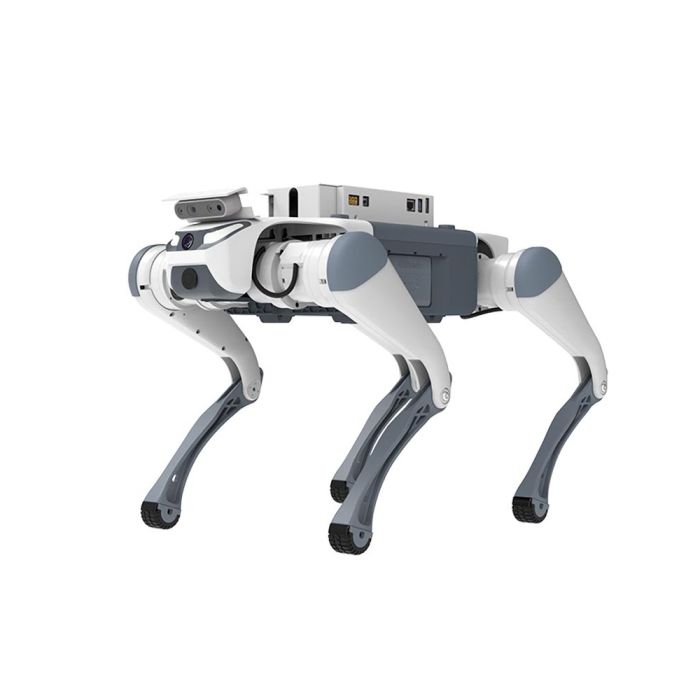
The Pro version is where the Lite3 becomes a perception platform as well as a locomotion platform. An RK3588 ARM-architecture processor runs the motion host. An NVIDIA Jetson Xavier NX runs the perception host, a configuration shared by the Pro and LiDAR versions. An Intel RealSense D435i depth camera is integrated. The robot offers front and rear obstacle stop, visual following and forward obstacle avoidance. It delivers enhanced joint torque (up 50%), faster response bandwidth and precise motion control. In legged robotics generally, assigning vision and control to separate computers lets demanding perception software run without crowding the processes that keep the machine balanced.
Technical Specifications
| Specification | Value |
|---|---|
| Standing dimensions (L × W × H) | 610 × 370 × 450 mm |
| Weight | 12.9 kg |
| Payload capacity | 4 kg |
| Maximum slope | 40° |
| Obstacle clearance | 18 cm |
| Continuous operation | 1.5 – 2 hours |
| Maximum range | 3.4 km |
| Perception features | Front/rear obstacle stop, visual following, forward obstacle avoidance |
| Interfaces | USB 3.0, HDMI, Ethernet; External Power Input (24V/12V/5V); Power Connector |
| Motion host | RK3588 ARM-architecture processor |
| Perception host | NVIDIA Jetson Xavier NX |
| Depth camera | Intel RealSense D435i (integrated) |
| Operating system | Ubuntu 20.04 |
| ROS compatibility | ROS1 (Noetic) and ROS2 (Foxy) |
| Protection | Overtemperature protection: stops and lies down automatically if motors overheat |
Specifications as published by the manufacturer; confirmed against the datasheet at quotation.
DEEP Robotics has not published joint torque figures, an IP rating, a battery capacity, a charging time or a maximum speed of its own; these are confirmed at quotation.
What does the Pro version add to the Lite3 platform?
The Pro version adds a second computer whose only task is to interpret the world. The Jetson Xavier NX perception host sits alongside the RK3588 motion host. Together with the integrated Intel RealSense D435i depth camera, it gives the robot the sensing and processing for its forward obstacle avoidance, its front and rear obstacle stop and its visual following behaviour. For a research team, this means a working perception pipeline is available on the robot from the outset. The team can study it, replace it or build on it, rather than assemble one from separate parts.
The interface set supports that work. USB 3.0, HDMI and Ethernet connect monitors, peripherals and network equipment directly. The external power input, offered at 24V, 12V and 5V, lets additional sensors or payload electronics draw power from the robot. The 4 kg payload capacity sets the limit for what can be carried. Because the robot runs Ubuntu 20.04 and is compatible with both ROS1 (Noetic) and ROS2 (Foxy), a laboratory can bring existing packages and habits with it rather than learning a proprietary environment.
How does the Lite3 Pro cope with real terrain?
A research robot earns its keep on the ground it actually has to cross. The Lite3 Pro climbs slopes of up to 40° and has an obstacle clearance of 18 cm. It handles 15 cm steps in its standard gait and 18 cm in AI Motion Mode. At 12.9 kg and 610 × 370 × 450 mm when standing, it is compact enough to move between a laboratory, a lecture theatre and an outdoor test area without special handling.
Continuous operation runs from 1.5 to 2 hours, with a maximum range of 3.4 km. That suits structured experimental sessions and teaching periods. The overtemperature protection matters in warm climates and during intensive testing: if the motors overheat, the robot stops and lies down of its own accord rather than continuing under strain. Students and researchers can push a gait or a controller hard knowing the platform has a defined, safe response when its limits are reached.
Who is the Deep Robotics Lite3 Pro Quadruped Robot Dog for?
The clearest fit is a university or institute research group whose work spans both perception and locomotion. This includes teams training reinforcement learning policies and deploying them on real hardware, groups studying visual navigation and following behaviours, and laboratories building embodied AI prototypes that need a mobile body with onboard computing. The ROS1 and ROS2 compatibility suits groups that already work in either generation of ROS or are moving between them.
Engineering and computer science departments that teach robotics form a second segment. The Pro version gives students a platform on which a single course can cover control, sensing and autonomy. Innovation centres and corporate research laboratories exploring legged robots before any industrial deployment form a third.
Groups whose research centres on 3D mapping, localisation and environmental reconstruction should also look at the Deep Robotics Lite3 LIDAR Quadruped Robot Dog, which shares the Jetson Xavier NX perception host and is the version oriented towards LiDAR-based work. Buyers comparing the full range can review the Deep Robotics Lite3 Basic Quadruped Robot Dog and the Deep Robotics Lite3 Venture Quadruped Robot Dog, or browse the wider Standard Quadrupeds category. Robots Middle East can advise on which version matches a given research programme.
What is the Deep Robotics Lite3 Pro Quadruped Robot Dog used for?
- Reinforcement learning research: trained locomotion and behaviour policies are tested on a physical quadruped rather than in simulation alone.
- Perception experiments: the depth camera and dedicated perception host support work on obstacle detection, avoidance and visual following.
- Robotics education: students gain hands-on experience with legged control, sensing and ROS development on one platform.
- Embodied AI prototyping: teams combine onboard computing and mobility to test autonomous behaviours in real spaces.
- Sensor and payload integration: the external power input and standard interfaces allow additional hardware to be mounted and tested.
- Locomotion studies: slopes, steps and obstacles provide a practical testbed for gait and motion control research.
Pricing and Availability
Robots Middle East supplies the Lite3 Pro on quotation, so that the offer reflects the configuration, accessories and support a particular institution requires. Delivery, customs and support are arranged with the quotation. To begin, please request a quotation for the Deep Robotics Lite3 Pro Quadruped Robot Dog, available on this page.
Frequently Asked Questions
What computers does the Lite3 Pro use?
An RK3588 ARM-architecture processor serves as the motion host, and an NVIDIA Jetson Xavier NX serves as the perception host. The Jetson Xavier NX perception host is fitted to the Pro and LiDAR versions.
Which software environments does it support?
The Lite3 supports Ubuntu 20.04 and is compatible with both ROS1 (Noetic) and ROS2 (Foxy).
What camera is fitted?
An Intel RealSense D435i depth camera is integrated into the robot.
How much can the Lite3 Pro carry?
The payload capacity is 4 kg. The external power input at 24V, 12V or 5V can supply additional equipment.
How long does it run on a charge?
Continuous operation runs from 1.5 to 2 hours, with a maximum range of 3.4 km.
What happens if the motors overheat?
Overtemperature protection makes the robot stop and lie down automatically, which protects both the hardware and the people working around it.
Where can I buy the Deep Robotics Lite3 Pro Quadruped Robot Dog and what does it cost?
Robots Middle East supplies the Lite3 Pro across the Middle East and prices it by individual quotation according to configuration and support requirements. Please request a quotation through this page.
Summary
Like a good microscope, the Deep Robotics Lite3 Pro Quadruped Robot Dog is valuable for what it lets a team see and test. Separate motion and perception hosts, an integrated RealSense D435i depth camera, standard interfaces and Ubuntu with ROS1 and ROS2 compatibility turn a compact quadruped into a research instrument. It climbs 40° slopes, clears 18 cm obstacles and stops safely when its motors run hot. For laboratories and departments across the Middle East ready to take their algorithms from the screen to the floor, with Robots Middle East handling quotation, delivery and support, this page is the starting point.
Specifications
General
Physical
Performance
Software
What's included
Downloads
Related Products
Out of stock