
Deep Robotics Lite3 LIDAR Quadruped Robot Dog
In stock
- BRAND:
- DEEP ROBOTICS
- PART #:
- Lite3 Venture
- ORIGIN:
- China
- AVAILABILITY:
- ALLOW 2-4 WEEKS FOR DELIVERY
- SKU:
- Deep-Robotics-Lite3-LIDAR
Deep Robotics Lite3 LIDAR Quadruped Robot Dog
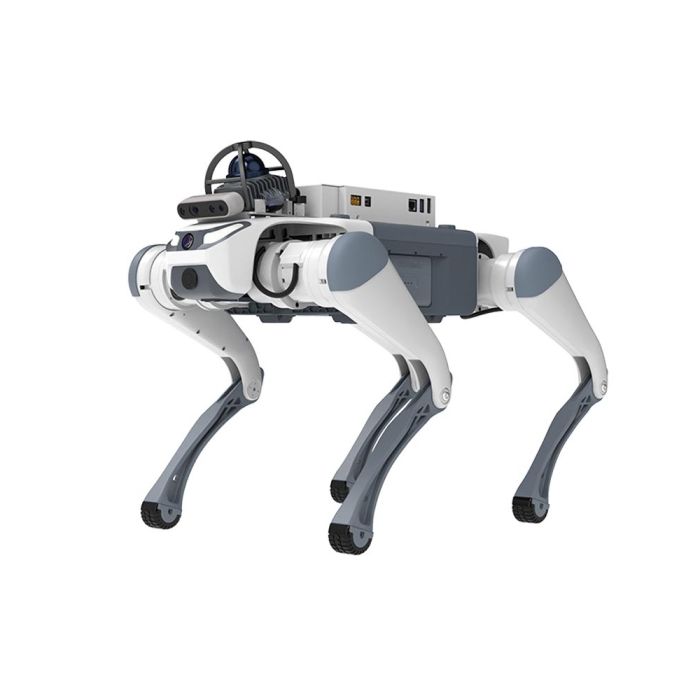
Inside a well-designed research robot, balance and perception do not compete for the same processor. One computer keeps four legs upright on uneven ground; another works out where the robot is and what lies ahead. The Deep Robotics Lite3 LIDAR Quadruped Robot Dog is built on that division of labour. An RK3588 ARM-architecture processor runs its motion host, while an NVIDIA Jetson Xavier NX serves as a separate perception host, fed by an Intel RealSense D435i depth camera and a LiDAR module. Each half of the work has its own computer, so a laboratory can push its navigation software hard without starving the gait controller.
Robots Middle East supplies the Lite3 LIDAR to universities, research centres, technical colleges and engineering teams across the Middle East. Robots Middle East prepares each quotation, arranges delivery and supports the robot after installation, so your team has a single, accountable point of contact from the first enquiry to the first mapped corridor.
Background
DEEP Robotics and the Lite3 family
DEEP Robotics develops legged robots that range from compact research platforms to industrial machines. The Lite3 is its compact quadruped, designed for academic research, reinforcement learning experiments and robotics education. The family is offered in Basic, Venture, Pro and LIDAR versions, all of which are grouped in our Lite Series. The versions share the same legged body, but they differ in how much perception and onboard computing they carry, which makes the choice of version a question of what your research programme actually needs to measure.
Where the LIDAR version sits
The LIDAR version is the configuration intended for work in which the robot must understand its surroundings, not merely move through them. It adds autonomous navigation to the perception functions of the family: front and rear obstacle stop, visual following and forward obstacle avoidance. With the Jetson Xavier NX perception host, the D435i depth camera and a Livox or Leishen LiDAR module, the platform is equipped for 3D mapping, localisation and environmental reconstruction. Beneath that perception layer, DEEP Robotics has given the Lite3 a 50% boost in joint torque, delivering high torque density, rapid response bandwidth and high reverse transmission efficiency for smoother, more precise movement across varied terrain.
Technical Specifications
| Specification | Value |
|---|---|
| Standing dimensions (L × W × H) | 610 × 370 × 496 mm |
| Weight | 13.5 kg |
| Payload capacity | 2.5 kg |
| Maximum slope | 40° |
| Obstacle clearance | 18 cm |
| Continuous operation | 1.5 – 2 hours |
| Maximum range | 2.7 km |
| Perception features | Autonomous navigation; front/rear obstacle stop; visual following; forward obstacle avoidance |
| Motion host | RK3588 ARM-architecture processor |
| Perception host | NVIDIA Jetson Xavier NX |
| Depth camera | Intel RealSense D435i |
| LiDAR modules | Livox or Leishen |
| Interfaces | USB 3.0, HDMI, Ethernet; External Power Input (24V/12V/5V); Power Connector |
| Operating system | Ubuntu 20.04 |
| ROS compatibility | ROS1 (Noetic) and ROS2 (Foxy) |
| Protection | Overtemperature protection: stops and lies down if motors overheat |
| Development resources | Motion SDK with example code and libraries on GitHub |
Specifications are as published by the manufacturer and are confirmed against the datasheet at quotation. The manufacturer has not published the IP rating, the maximum speed of this version, the battery capacity, the LiDAR range or a service life for the robot; Robots Middle East confirms these points with your quotation.
Why does the Lite3 LIDAR use two separate computers?
Legged locomotion is unforgiving of delay. A quadruped adjusts its joints continuously to stay balanced, and any interruption in that control loop shows up immediately as a stumble. Perception, by contrast, is heavy and bursty: building a point cloud, matching it against a map and planning a path can occupy a processor for long stretches. Running both on one chip forces a compromise between them.
The Lite3 LIDAR avoids that compromise by assigning the motion host to the RK3588 and the perception host to the Jetson Xavier NX. For a research group, this has a practical consequence: you can develop, test and occasionally crash experimental perception code on the Jetson without placing the robot's balance at the mercy of your latest build. It also mirrors the architecture of many larger autonomous systems, which makes the Lite3 LIDAR a useful teaching instrument for students who will later work on full-scale robots. Both hosts work within Ubuntu 20.04, and compatibility with ROS1 (Noetic) and ROS2 (Foxy) means existing ROS packages for mapping, localisation and planning can be brought onto the robot rather than rewritten.
What does the LIDAR version add to the Lite3 platform?
The headline addition is autonomous navigation, built on the combination of the Jetson Xavier NX, the D435i depth camera and a LiDAR module. The depth camera gives the robot a dense picture of what lies close in front of it, while LiDAR provides the geometry needed for 3D mapping, localisation and environmental reconstruction. Together they turn the Lite3 from a locomotion platform into a mobile sensing platform.
The physical envelope remains that of a compact research robot: a standing footprint of 610 × 370 × 496 mm, a weight of 13.5 kg, a 2.5 kg payload, a maximum slope of 40° and an obstacle clearance of 18 cm. The interfaces — USB 3.0, HDMI, Ethernet and an external power input at 24V, 12V and 5V — allow additional sensors or computing modules to be attached for specific experiments. Overtemperature protection brings the robot to a stop and lays it down if its motors overheat, which protects the hardware during long or demanding test sessions. Support for both Livox and Leishen LiDAR modules gives research teams flexibility in their choice of sensor.
Who is the Deep Robotics Lite3 LIDAR Quadruped Robot Dog for?
The Lite3 LIDAR suits university laboratories working on SLAM, autonomous navigation and mobile perception, where the robot itself is the object of study as well as the carrier of sensors. Postgraduate researchers can use it to validate algorithms on real hardware, and teaching staff can build practical modules around ROS, sensor fusion and path planning on a platform small enough for a classroom or a corridor.
Research centres and innovation units in the region exploring legged robots for inspection or campus logistics concepts will find it a manageable entry point before committing to larger machines. Robotics clubs and competition teams with an advanced programme may also benefit from its open development environment and the Motion SDK.
Not every group needs the full perception stack. Teams concentrating on gait control and reinforcement learning for locomotion may find the Deep Robotics Lite3 Basic Quadruped Robot Dog or the Deep Robotics Lite3 Venture Quadruped Robot Dog a better fit, since the Jetson Xavier NX perception host is specified for the Pro and LIDAR versions. Groups that want the perception host but are still weighing their sensor configuration can compare the Deep Robotics Lite3 Pro Quadruped Robot Dog. For the wider range of four-legged platforms, see our Standard Quadrupeds category.
What is the Deep Robotics Lite3 LIDAR Quadruped Robot Dog used for?
- SLAM research — building and testing mapping and localisation algorithms with LiDAR and depth data on a moving legged base.
- Autonomous navigation studies — developing path planning and obstacle avoidance that must cope with the motion of a walking robot.
- Reinforcement learning experiments — transferring learned locomotion and navigation policies from simulation to real hardware.
- Robotics education — teaching ROS1, ROS2, sensor fusion and embedded computing through hands-on laboratory sessions.
- Environmental reconstruction — producing 3D models of indoor spaces, corridors and test areas for analysis.
- Sensor integration projects — attaching additional payloads through USB 3.0, Ethernet and the external power input for custom experiments.
Pricing and Availability
Robots Middle East prices the Lite3 LIDAR by quotation, so that the configuration, the fitted LiDAR module and any accessories match your project precisely. Delivery, customs clearance and after-sales support are arranged together with your quotation. Tell us about your institution, your research aims and your preferred configuration, and our team will respond with a tailored proposal. To begin, the quotation request form is available on this page.
Frequently Asked Questions
Which software environments does the Lite3 LIDAR support?
The robot runs Ubuntu 20.04 and is compatible with both ROS1 (Noetic) and ROS2 (Foxy). A Motion SDK with example code and libraries is available from DEEP Robotics on GitHub.
Which LiDAR module is fitted?
The Lite3 platform supports Livox or Leishen LiDAR modules for 3D mapping, localisation and environmental reconstruction. Our team will advise on the module that best suits your project.
How long does the robot operate on a charge?
The Lite3 LIDAR offers 1.5 – 2 hours of continuous operation. That is enough for a full laboratory session or a series of mapping runs.
How much can the Lite3 LIDAR carry?
The payload capacity is 2.5 kg. This allows small additional sensors or computing modules to be mounted for research work.
What terrain can it handle?
The robot climbs slopes of up to 40° and clears obstacles of up to 18 cm. If you plan to use it outdoors in dust or rain, please discuss this with our team before ordering.
What happens if the motors overheat?
Overtemperature protection stops the robot and lays it down automatically. This protects the motors during long or demanding experiments.
Where can I buy the Deep Robotics Lite3 LIDAR Quadruped Robot Dog and what does it cost?
You can buy it from Robots Middle East, which supplies institutions and companies across the Middle East. The price depends on configuration and is provided in a tailored quotation that you can request on this page.
Summary
The Lite3 LIDAR gives balance and perception a computer each: the RK3588 keeps the robot steady while the Jetson Xavier NX, the D435i depth camera and a LiDAR module build its understanding of the space around it. That separation lets research teams experiment freely with mapping, localisation and autonomous navigation on a compact legged platform, supported by Ubuntu 20.04, ROS1 and ROS2, and the Lite3 Motion SDK. For laboratories and teaching programmes across the Middle East that want legged robots to see as well as walk, and for a quotation from Robots Middle East that covers delivery, customs and support, this page is the starting point.
Specifications
General
Physical
Performance
Software
What's included
Downloads
Related Products
Out of stock