
MagicLab MagicDog Y1 Quadruped Robot Dog
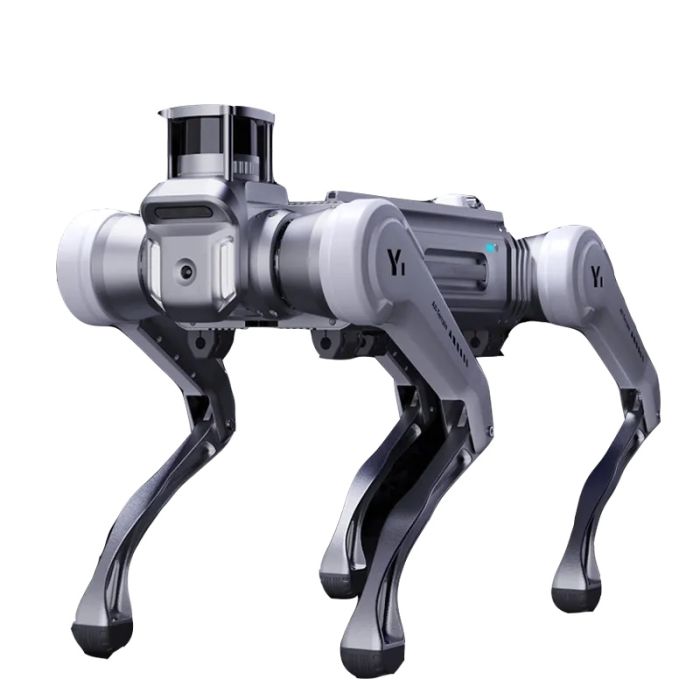
In stock
- BRAND:
- MAGICLAB
- MODEL:
- MAGICDOG Y1
- ORIGIN:
- China
- Warranty:
- 12 MONTHS
- AVAILABILITY:
- SUBJECT TO AVAILABILITY
- SKU:
- MagicLab-MagicDog-Y1
MagicLab MagicDog Y1 Quadruped Robot Dog
For most of history, the answer to moving equipment across ground that no cart could cross was an animal with four legs: a mule on a mountain track, a pack horse fording a stream. Industry has since replaced that animal with wheels and tracks almost everywhere, until the route includes a flight of stairs, a flooded culvert or a loose, rocky slope. The MagicLab MagicDog Y1 Quadruped Robot Dog returns to the four-legged answer, but with a sealed aircraft-grade body, serious onboard computing and a frame of mounting points built for the instruments that inspection teams rely on. It is a working animal for sites where the ground, the weather and the task all refuse to be simple.
Robots Middle East supplies the MagicDog Y1 to organisations across the Middle East, from utilities, energy operators and industrial estates to research institutions and system integrators. Our team prepares each quotation around the configuration you require, arranges delivery to your site and remains your point of contact for support once the robot is in service.
Background
MagicLab and its turn towards industry
MagicLab develops legged and humanoid robots, and its range includes the MagicBot humanoid platforms alongside its MagicDog quadrupeds. On October 10, 2025, MagicLab released the MagicDog Y1 as its first new-generation product targeting industry applications. That positioning matters: rather than a consumer or demonstration machine, the Y1 is an industrial quadruped robot, with its specification shaped around endurance, environmental protection and the ability to carry and power third-party equipment in the field.
A platform built to be extended
The defining idea of the Y1 is that the robot is a carrier for a mission, not the mission itself. Its base computing is an 8-Core High-Performance CPU, and an extended High-Performance Computing Module rated at 157 TOPS provides headroom for perception and on-board analysis. Around that sits a generous set of user expansion interfaces supplying both power and data, plus mounting holes for extension boards, sliding rails, screw mounts and a payload platform. Supported expansion devices include an infrared thermal imager, a dual-light PTZ camera, a gas sensor, an acoustic imager and a partial discharge sensor, among others. For an operator, this means the same chassis can be fitted for a substation round one month and a gas-detection patrol the next.
Technical Specifications
| Specification | Value |
|---|---|
| Product type | MagicLab Industrial Quadruped Robot MagicDog Y1 |
| Dimensions (L × W × H) | 1050mm×458mm×810mm |
| Total weight (with battery) | 70Kg (with Battery) |
| Maximum payload | 150kg |
| Dynamic payload | 45kg |
| Maximum speed | 6m/s |
| Maximum climbing height | ≥60cm |
| Maximum slope angle | ≥45° |
| Battery capacity | 45Ah (2400Wh), Voltage 54V |
| Operating time | 4–6h (>4 h continuous walking with 20 kg load) |
| Ingress protection rating | IP67 |
| Operating temperature | -20℃ to 55℃ |
| Body | Aircraft-grade material |
| Base computing power | 8-Core High-Performance CPU |
| Extended computing power | High-Performance Computing Module (157 TOPS) |
| Communication module | Wi-Fi 6, BT 5.2, 5G Communication Module (optional for some versions) |
| Perception sensors | 3D LiDAR ×1 + Depth Cameras ×2 + Optical Cameras ×2 (configurations may vary) |
| User expansion interfaces | (24V+485 output)*4 power supply + power bus, USB3.0*4, (12V output+EthNet)*3 power supply + network; EthCat x 1 |
| Mounting holes for expansion parts | Extension Boards, Sliding Rails, Screw Mounts, Payload Platform |
| Supported expansion devices | Infrared Thermal Imager, Dual-Light PTZ Camera, Gas Sensor, Acoustic Imager, Partial Discharge Sensor, etc. |
Specifications are as published by the manufacturer and are confirmed against the datasheet at quotation.
MagicLab has not published the degrees of freedom, joint torque, maximum power, charging time, camera resolution, operating system or SDK support, noise level, maximum step height or package contents; these are confirmed with you at quotation.
What is the difference between maximum payload and dynamic payload on the MagicDog Y1?
The Y1 carries two payload figures, and reading them correctly is the key to planning a deployment. The maximum payload of 150kg describes how much load the robot's structure can bear, while the dynamic payload of 45kg is the load it is rated to carry while moving. For practical planning, the dynamic figure is the one that governs what you can mount for a patrol or a transport run: sensor heads, a thermal camera, a gas detector, a communications relay or a small toolkit.
Endurance should be read alongside it. The Y1 has an operating time of 4–6h, with more than 4 h of continuous walking while carrying a 20 kg load, drawn from a 45Ah (2400Wh) battery at 54V. In other words, a typical inspection payload still leaves room for a substantial working session, which is what allows the robot to cover a full round of a site rather than a short demonstration loop. Where a mission calls for heavier instruments, the payload platform and sliding rails make it possible to balance the load on the body, and our team can help you size the configuration before you commit.
How does the MagicDog Y1 cope with heat, dust and difficult terrain?
For buyers in the Middle East, environmental tolerance is rarely an afterthought. The Y1 combines an aircraft-grade material body with IP67 protection and operates stably from -20℃ to 55℃ in high temperature, cold, wind, sand, rain and snow. That upper limit and the sand protection are directly relevant to desert pipelines, solar farms and outdoor industrial yards, where airborne dust defeats many unsealed machines.
On the ground, the robot is designed to conquer 45° slopes, stairs, rocky surfaces and shallow waters, with a maximum slope angle of ≥45° and a maximum climbing height of ≥60cm. This is where the legged format earns its place over a wheeled or tracked vehicle: a quadruped can step over obstacles and climb steps that would halt a rover, which opens up plant rooms, mezzanines, embankments and drainage channels. Its perception suite, built on a 3D LiDAR, two depth cameras and two optical cameras, gives the robot the awareness it needs to navigate such spaces, and a top speed of 6m/s allows it to cross open ground quickly between inspection points.
Who is the MagicDog Y1 for?
The clearest fit is the operator of large or hazardous infrastructure. Electricity utilities and substation owners can pair the Y1 with the partial discharge sensor, acoustic imager and infrared thermal imager to automate routine rounds that would otherwise expose staff to live equipment. Oil, gas and petrochemical operators will look to the gas sensor and dual-light PTZ camera for leak detection and remote visual checks across sprawling plants.
Security and facilities teams responsible for perimeters, warehouses and industrial estates form a second segment, valuing a sealed platform that can patrol outdoors through heat and dust. Mining, tunnelling and construction companies form a third, where uneven ground and stairs are the everyday condition rather than the exception.
Finally, system integrators, universities and corporate research laboratories will be drawn to the combination of 157 TOPS of extended computing and power-and-data expansion interfaces, which make the Y1 a capable base for developing their own payloads and autonomy software. Those comparing it with other platforms may find it useful to browse our Standard Quadrupeds and Research Robots categories, and Robots Middle East can advise on which option matches the mission.
What is the MagicDog Y1 used for?
- Substation and power inspection — automated rounds with thermal, acoustic and partial discharge sensing near live equipment.
- Gas and leak detection — patrols of petrochemical plants and pipelines carrying a gas sensor and PTZ camera.
- Perimeter and site security — outdoor patrols across yards and estates in heat, wind and dust.
- Tunnels, mines and utility corridors — access to confined, uneven routes with stairs and standing water.
- Field transport of equipment — carrying instruments or tools across terrain that wheeled vehicles cannot reach.
- Research and payload development — a powered, networked base for testing new sensors and autonomy software.
Pricing and Availability
Because the Y1 is configured around its mission, from the communication module to the expansion devices mounted on its body, Robots Middle East quotes each order individually rather than publishing a single figure. Delivery, customs clearance and after-sales support are arranged together with your quotation. To receive a quotation for your configuration, please use the request form available on this page.
Frequently Asked Questions
Is the MagicDog Y1 suitable for outdoor use in hot, dusty climates?
Yes. It has IP67 protection and an aircraft-grade material body, and it operates stably from -20℃ to 55℃, including in sand, wind and rain.
How long can the MagicDog Y1 operate on one battery?
The operating time is 4–6h, with more than 4 h of continuous walking while carrying a 20 kg load. The battery is rated at 45Ah (2400Wh), 54V.
Can the robot climb stairs?
Yes. The Y1 handles stairs, rocky surfaces, shallow water and slopes, with a maximum slope angle of ≥45° and a maximum climbing height of ≥60cm.
Which sensors can be added to the MagicDog Y1?
Supported expansion devices include an infrared thermal imager, a dual-light PTZ camera, a gas sensor, an acoustic imager and a partial discharge sensor, among others. They attach via extension boards, sliding rails, screw mounts or the payload platform.
Does the MagicDog Y1 support 5G connectivity?
The Y1 provides Wi-Fi 6 and BT 5.2, and a 5G communication module is optional for some versions.
What computing power does the MagicDog Y1 carry?
The base computing is an 8-Core High-Performance CPU, extended by a High-Performance Computing Module rated at 157 TOPS for perception and on-board analysis.
Where can I buy the MagicLab MagicDog Y1 Quadruped Robot Dog and what does it cost?
You can buy it from Robots Middle East, which supplies and supports the Y1 across the Middle East. The cost depends on the configuration you choose, so we provide it in a tailored quotation requested through this page.
Summary
The pack animal was never replaced on the hardest routes because nothing else could follow the path. The MagicDog Y1 takes up that role for modern industry: a four-legged, IP67-sealed carrier that climbs stairs and slopes, works through heat and sand, and brings power, data and computing to whichever instruments the job demands. For utilities, energy operators, security teams and research groups across the Middle East that need inspection or transport where wheels give up, Robots Middle East can configure, deliver and support it, and this page is the starting point.