
Unitree D1-T Teleoperation Robot Arm
In stock
- BRAND:
- UNITREE ROBOTICS
- MODEL:
- GO2 SERVO ROBOTIC ARM
- ORIGIN:
- China
- AVAILABILITY:
- SUBJECT TO AVAILABILITY
- SKU:
- Unitree-D1-T
Unitree D1-T Teleoperation Robot Arm
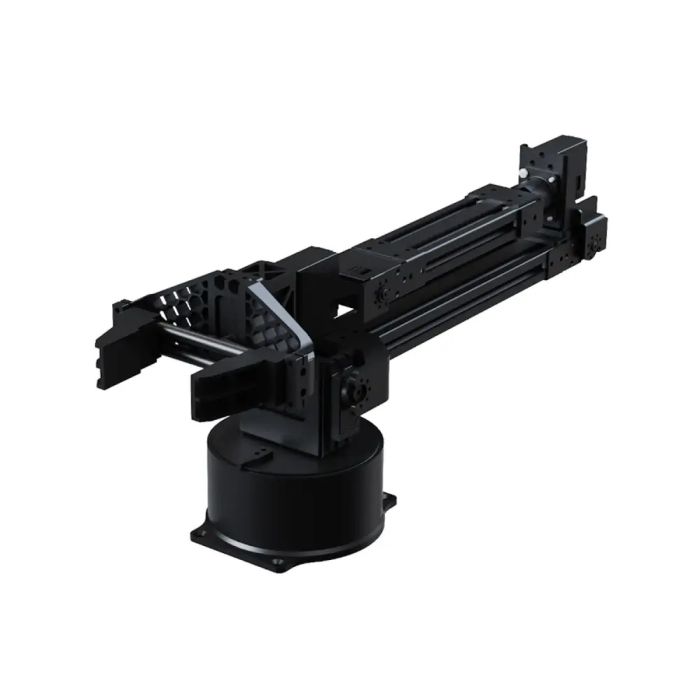
Industrial manipulators usually arrive with a control cabinet, a safety fence and a commissioning engineer. The Unitree D1-T Teleoperation Robot Arm asks for three connections instead: a DC5.5-2.1 socket for its 24V supply, an RJ45 port for communication and a Type-C port for serial debugging. That short list says a great deal about its purpose. This is a compact aluminium-alloy manipulator with six joints and a gripper. It is meant to sit on a bench, connect to a computer and begin gathering the motion data on which embodied AI depends, without the infrastructure that a production cell requires.
Robots Middle East supplies the Unitree D1-T Teleoperation Robot Arm to universities, research institutes, system integrators and technology companies across the Middle East. Our team prepares each quotation for the kit edition you require and arranges delivery to your laboratory or facility. We also remain your point of contact for technical support once the arm is in use.
Background
Unitree Robotics and its move into manipulation
The arm is manufactured by Yushu Technology Co., Ltd., the company that trades as Unitree Robotics. Unitree built its reputation on legged robots, quadrupeds and humanoids that brought agile locomotion within reach of laboratories and developers beyond the largest research groups. A robot arm is a logical next step. Once a machine can move through a space, the question becomes what it can do with the objects it finds there. The D1 arm carries Unitree's approach of approachable, developer-friendly hardware into manipulation, and the D1-T presents that arm in a teleoperation kit.
Positioned for data acquisition and continuous learning
Unitree positions the arm as a leading choice for embodied intelligent assistants, unlocking the limitless potential of data acquisition and continuous learning. In practical terms, teleoperation is one of the most direct ways to teach a robot. A person demonstrates a task and the robot reproduces it. The recorded trajectories, joint states and camera images then become training material for learning-based control. The D1 supports this work with position control, velocity control and force control, and it offers both low-level and high-level interfaces. Developers can therefore command the bus servo motors directly or work through more advanced functions. The arm also accepts external devices such as cameras and mobile robot chassis, so a single platform can grow from a bench experiment into a broader system.
Technical Specifications
| Specification | Value |
|---|---|
| Model | D1 |
| Degrees of freedom | Six joints and a gripper |
| Weight | About 2.37kg |
| Arm length | 670mm |
| Reach | 550mm (gripper not included), 670mm (gripper included) |
| Payload | 500g |
| Material | Aluminium alloy |
| Motor type | Bus Servo |
| Control modes | Position control, velocity control, force control |
| Control interfaces | Low-level and high-level interfaces for direct servo control and advanced functions |
| Power supply | 24V 2.5A (MAX 5A) |
| Power | 60W |
| Interface | DC5.5-2.1 (Power Supply) + RJ45 (Communication) + Type-C (Serial Port Debugging) |
| External hardware | Cameras, mobile robot chassis and similar devices |
| Kit editions | Dual-Arm AI Teleoperation Kit (Standard Edition); Quad-Arm AI Teleoperation Kit (Full Edition) |
Specifications are as published by the manufacturer and are confirmed against the datasheet at quotation.
Unitree has not published the repeatability, the joint travel ranges, the joint speeds, the operating temperature, the ingress protection rating, the box contents of a single arm or the software SDK support; each of these is confirmed with your quotation.
What makes the D1-T different from a conventional industrial robot arm?
Conventional industrial arms are designed for throughput. They repeat a fixed programme for years, inside guarding, under controllers that are configured once and then rarely touched. The D1-T reverses almost every one of those priorities. At about 2.37kg it can be lifted and repositioned by one person. It draws 60W from a 24V supply, so an ordinary laboratory power outlet is enough to run it. Its communication runs over a standard RJ45 connection rather than a proprietary cabinet, and a Type-C port gives developers serial access for debugging.
The control model differs as well. Industrial arms usually present a single programming environment to the user. The D1 exposes low-level interfaces for commanding the servo motors directly, alongside high-level interfaces for advanced functions. Its choice of position, velocity and force control matters for learning research. Force control in particular allows experiments in which the arm responds to contact rather than simply following a trajectory. The six joints and gripper provide the freedom of movement needed to approach objects from varied angles, which matters when demonstrations must cover more than a single fixed pick-and-place motion.
The result is an arm built for iteration. It suits a team that changes its task every week, records data every day and needs hardware that keeps pace with its software.
How do the Standard and Full Editions differ?
Unitree offers the D1-T in two kits: the Dual-Arm AI Teleoperation Kit (Standard Edition) and the Quad-Arm AI Teleoperation Kit (Full Edition). The specification above describes the D1 arm itself, and the edition names describe the number of arms each kit contains. In teleoperation, arms are commonly worked in pairs, with one arm guided by the operator and another reproducing the motion. A larger kit therefore generally opens the door to two-handed tasks, which are central to much current research into household and service manipulation. Robots Middle East sets out what each edition includes in your quotation, so that you commit to a configuration knowing exactly what will arrive.
Who is the Unitree D1-T Teleoperation Robot Arm for?
The clearest audience is the research group working on embodied AI and imitation learning. For these teams, the bottleneck is high-quality demonstration data, and an arm built around teleoperation and data acquisition addresses that need directly. University departments form a second audience. The arm's light build, standard connections and accessible control modes make it well suited to teaching kinematics, control theory and robot learning in a laboratory setting, where students need to handle the hardware themselves.
Developers of mobile manipulators are a third group. Because the D1 accepts external devices such as cameras and mobile robot chassis, it can serve as the manipulation layer on a moving platform. System integrators and corporate innovation teams make up a fourth audience, using the arm to prototype concepts before they invest in heavier hardware.
When choosing between kits, a team starting with a single teleoperation station may find the Standard Edition sufficient. Groups planning bimanual experiments should look closely at the Full Edition. Buyers comparing other manipulators in the range can browse Unitree Arms or view the separately listed Unitree Go2 Servo Robotic Arm D1. Accessories for legged platforms are gathered under Quadruped Accessories.
What is the Unitree D1-T Teleoperation Robot Arm used for?
- Demonstration data collection: recording operator-guided motions as training datasets for robot learning models.
- Imitation learning research: testing policies that reproduce human demonstrations of grasping and placing objects.
- Force-control experiments: studying contact-rich tasks using the arm's force control mode.
- Robotics education: giving students direct, hands-on access to servo-level and high-level arm control.
- Mobile manipulation prototyping: combining the arm with a mobile robot chassis and cameras to build a moving assistant.
- Embodied assistant development: developing and evaluating early concepts for intelligent assistants that handle everyday objects.
Pricing and Availability
Robots Middle East supplies the Unitree D1-T Teleoperation Robot Arm on a quotation basis. Each quotation is prepared for the edition you choose and the place where the arm will be used. Please tell us whether the Standard or the Full Edition suits your programme, and describe the cameras, chassis or other hardware you intend to connect, so that our team can advise on integration and kit contents. Delivery, customs clearance and after-sales support are arranged together with your quotation. To begin, the quotation request for the Unitree D1-T Teleoperation Robot Arm is available on this page.
Frequently Asked Questions
How much can the D1-T lift?
The D1 arm has a payload of 500g. This suits light objects of the kind typically used in manipulation research and teaching.
What reach does the arm offer?
The reach is 550mm without the gripper and 670mm with the gripper included.
What power does the arm need?
It runs on a 24V 2.5A supply (MAX 5A), with a power rating of 60W, connected through a DC5.5-2.1 socket.
Which control modes are supported?
The arm supports position control, velocity control and force control. These are available through both low-level and high-level interfaces.
Can I connect cameras or a mobile base?
Yes. The arm can be connected to external devices such as cameras and mobile robot chassis, combining with different scene applications to achieve more diverse functions.
What motors and materials does the arm use?
The arm is driven by bus servo motors and built from aluminium alloy, which keeps its weight to about 2.37kg.
Where can I buy the Unitree D1-T Teleoperation Robot Arm and what does it cost?
You can buy it from Robots Middle East, which supplies customers across the Middle East. The cost depends on the edition and the delivery arrangements, so please request a quotation on this page.
Summary
The D1-T is defined as much by what it leaves out as by what it includes. Where a production arm needs a cabinet, a cell and a commissioning schedule, this aluminium-alloy arm needs a 24V supply, an Ethernet cable and a Type-C lead. That simplicity is deliberate. With six joints and a gripper, position, velocity and force control, and both low-level and high-level interfaces, it gives researchers, educators and developers a practical way to collect demonstration data and advance embodied AI on an ordinary bench. The Standard and Full Editions let a team match the kit to the scale of its experiments, and Robots Middle East brings the edition, delivery and support together in a single quotation. For anyone ready to start teaching robots by demonstration, this page is the starting point.
Specifications
General
Physical
Shipping
What's included
Related Products
Out of stock