
Unitree G1 Competition Humanoid Robot
In stock
- BRAND:
- UNITREE ROBOTICS
- PART #:
- G1-Comp
- ORIGIN:
- China
- AVAILABILITY:
- SUBJECT TO AVAILABILITY
- SKU:
- Unitree-G1-Comp
Unitree G1 Competition Humanoid Robot
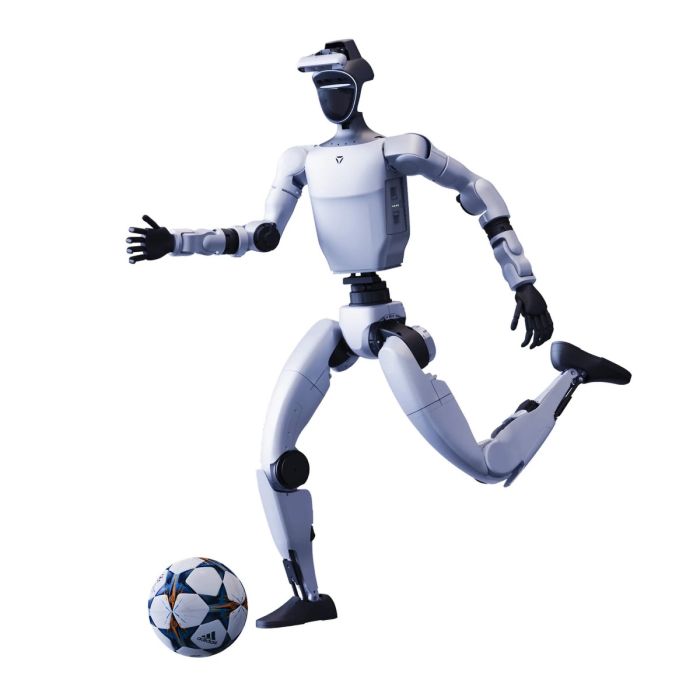
A competition humanoid spends far more of its working life in transit, on a charging bench or inside a simulator than it ever spends on the pitch, and a team's results are shaped as much by those quiet hours as by the minutes of play. The Unitree G1 Competition Humanoid Robot is designed with that whole cycle in view. It is a bipedal platform that folds down for transport, takes a quick-release battery between matches and runs the control software a team has refined at its desks long before the tournament begins. Unitree positions it as a football icon designed for competitions, and its specification reads less like a showpiece and more like a working kit for teams who must arrive, set up and perform to a fixed timetable.
Robots Middle East supplies the Unitree G1 Competition Humanoid Robot to universities, schools, research laboratories and robotics clubs across the Middle East. Each quotation from Robots Middle East is prepared for the specific configuration requested, and Robots Middle East arranges delivery, customs documentation and after-sales support for buyers throughout the region.
Background
Unitree Robotics and the G1 family
Unitree Robotics was established in 2016 and has advanced to the mass production of robot dogs and humanoid robots. That experience in building legged machines in volume is the foundation of the G1 family, which the sources name in three versions: G1, G1 EDU and G1-Comp. The figures in this article belong to the G1-Comp version alone. Where a buyer is weighing one version against another, the comparison should be made against each version's own figures rather than by assuming that the members of the family share them.
A competition variant built around perception and software
What sets the G1-Comp apart in its positioning is the attention given to the information a player needs during a match. The robot combines a depth camera with a 3D LiDAR, and its visual recognition interface includes the YOLO11 real-time target detection algorithm, providing a rich stadium information interface. Behind the sensors sits an Orin NX development computing unit providing 100TOPS of AI computing power, so detection and decision-making can run on the robot itself. The platform is open to secondary development, compatible with the ROS ecosystem, and supported in the Isaac gym and Mujoco simulation environments, which allows a team to write and test behaviour virtually before committing it to hardware.
Technical Specifications
| Specification | Value |
|---|---|
| Positioning | Football icon designed for competitions |
| Dimensions standing (H x W x T) | 1320x450x200mm |
| Dimensions folded (H x W x T) | 690x450x300mm |
| Weight (with battery) | About 35kg+ |
| Total degrees of freedom | 25-45 |
| Head degrees of freedom | 2 |
| Single leg degrees of freedom | 6 |
| Maximum knee joint torque | 120N·m |
| Arm maximum load | About 3Kg |
| Development computing unit | Orin NX, 100TOPS AI computing power |
| Sensing | Depth camera, 3D LiDAR |
| Connectivity | WiFi 6, Bluetooth 5.2 |
| Battery | Smart Battery (Quick Release) 9000mAh |
| Charger | 54V 5A |
| Battery life | About 2h |
| Secondary development | Yes |
| Simulation environment | Isaac gym, Mujoco |
| Visual recognition API | Built-in YOLO11 real-time target detection algorithm |
| ROS support | Compatible with ROS ecosystem |
| Shell | Aluminium alloy and high-strength engineering plastics |
Specifications are as published by the manufacturer and are confirmed against the datasheet at quotation.
The manufacturer has not published the maximum walking speed, the IP rating, the camera model, the box contents or the operating temperature; these are confirmed at quotation.
What makes the G1-Comp suited to tournaments rather than demonstrations?
A demonstration robot needs to impress once; a tournament robot needs to repeat its performance across a series of matches, often in an unfamiliar venue. Several elements of the G1-Comp specification address that difference directly. The robot folds from a standing size of 1320x450x200mm to 690x450x300mm, which makes transport between campus, training hall and competition venue considerably more manageable. Its Smart Battery is quick-release, with a capacity of 9000mAh and a battery life of about 2h, so a team can plan its match schedule around exchanging packs rather than waiting for a single battery to recharge.
Physical contact and falls are part of robot football, and the shell is covered with aluminium alloy and high-strength engineering plastics. The legs each carry 6 degrees of freedom, and the knee joint delivers a maximum torque of 120N·m, the joint that bears much of the load when a bipedal robot walks, turns, kicks or rises from the ground. The head has 2 degrees of freedom, allowing the sensors to be directed towards the ball or the opponents without the whole body having to turn. Taken together, these choices make it a machine built to be handled, carried and played hard, rather than kept behind a display rope.
How does the G1-Comp support a team's software workflow?
For most competition teams, the robot is the final stage of a long chain of software work. The G1-Comp supports secondary development, so teams are not confined to the behaviours supplied by the manufacturer. Compatibility with the ROS ecosystem means that existing packages, tools and the experience of students and researchers can be carried across, while support for Isaac gym and Mujoco allows locomotion and strategy to be trained and tested in simulation before they reach the physical robot.
On the robot, the Orin NX unit with 100TOPS of AI computing power runs perception and control locally, and the built-in YOLO11 detection algorithm gives developers a ready starting point for recognising objects on the pitch. WiFi 6 and Bluetooth 5.2 provide wireless links for development, monitoring and communication. The result is a workflow in which the hardware stays consistent and the competitive edge comes from the team's own code, which is precisely where most robotics competitions intend the contest to be decided.
Who is the Unitree G1 Competition Humanoid Robot for?
The clearest audience is the robot football team, whether at a university, a technical college or an independent club, that wants a humanoid platform positioned specifically for competition. Such teams benefit most from the combination of onboard detection, simulation support and a body designed to fold for travel.
University research groups working on bipedal locomotion, real-time perception or multi-agent coordination form a second audience. Competition settings offer a demanding, repeatable test environment, and the open development stack allows results from the laboratory to be published and reproduced.
Schools and STEM programmes that run robotics clubs or enter student competitions can use the platform as a focal point for teaching programming, computer vision and engineering teamwork, with appropriate supervision given the size and weight of the robot.
Event organisers, science centres and innovation hubs that host robotics tournaments or exhibitions form a further group. Buyers whose work is not focused on competition, or who are considering another member of the G1 family, are invited to ask Robots Middle East to compare the specification of each version for their intended use before ordering.
What is the Unitree G1 Competition Humanoid Robot used for?
- Robot football competitions: fielding a humanoid player built for organised matches and tournaments.
- Locomotion research: studying bipedal walking, balance, turning and recovery from falls on a full-size platform.
- Computer vision development: building and testing object detection on top of the built-in YOLO11 algorithm.
- Simulation-to-hardware transfer: training behaviours in Isaac gym or Mujoco and validating them on the physical robot.
- Robotics education: giving students a shared platform for programming, perception and teamwork projects.
- Public demonstrations and events: presenting humanoid robotics to audiences at exhibitions, open days and tournaments.
Pricing and Availability
The Unitree G1 Competition Humanoid Robot is supplied on a quotation basis, so that the configuration, accessories and support requirements of each buyer are reflected accurately. Robots Middle East prepares the quotation once the intended use, the number of units and the destination are known. Delivery, customs clearance and after-sales support are arranged together with the quotation. To begin the process, the request form for a quotation is available on this page.
Frequently Asked Questions
What is the Unitree G1 Competition Humanoid Robot designed for?
Unitree positions the G1-Comp as a football icon designed for competitions. It combines a bipedal body, onboard perception and an open development stack for teams taking part in robot football.
Which sensors does the G1-Comp use?
The robot uses a depth camera and a 3D LiDAR. Its visual recognition interface includes the built-in YOLO11 real-time target detection algorithm.
How long does the battery last?
The Smart Battery has a capacity of 9000mAh and a battery life of about 2h. It is quick-release, which allows packs to be exchanged between sessions.
Can teams write their own software for the robot?
Yes. The G1-Comp supports secondary development, is compatible with the ROS ecosystem and is supported in the Isaac gym and Mujoco simulation environments.
How large and heavy is the robot?
Standing, it measures 1320x450x200mm, and folded it measures 690x450x300mm. Its weight with battery is about 35kg+.
What computing power does the robot carry?
The G1-Comp uses an Orin NX development computing unit that provides 100TOPS of AI computing power. This allows perception and control to run on the robot during a match.
Where can I buy the Unitree G1 Competition Humanoid Robot and what does it cost?
The Unitree G1 Competition Humanoid Robot is available from Robots Middle East, which supplies buyers across the Middle East. The cost depends on the configuration and requirements, and is set out in a quotation prepared for each request.
Summary
The minutes of play are what spectators remember, yet a competition humanoid is judged equally by how it travels, how quickly it returns to the pitch and how faithfully it carries out the code its team has written. The Unitree G1 Competition Humanoid Robot addresses each of those hours: a folding body and a quick-release battery for the journey and the pit stop, a depth camera, 3D LiDAR and YOLO11 detection for the match itself, and an Orin NX unit with simulation and ROS support for the long weeks of development in between. Robots Middle East supplies, delivers and supports the robot across the region, and for any team preparing for its next tournament, this page is the starting point.
Specifications
General
What's included
Related Products
Out of stock