
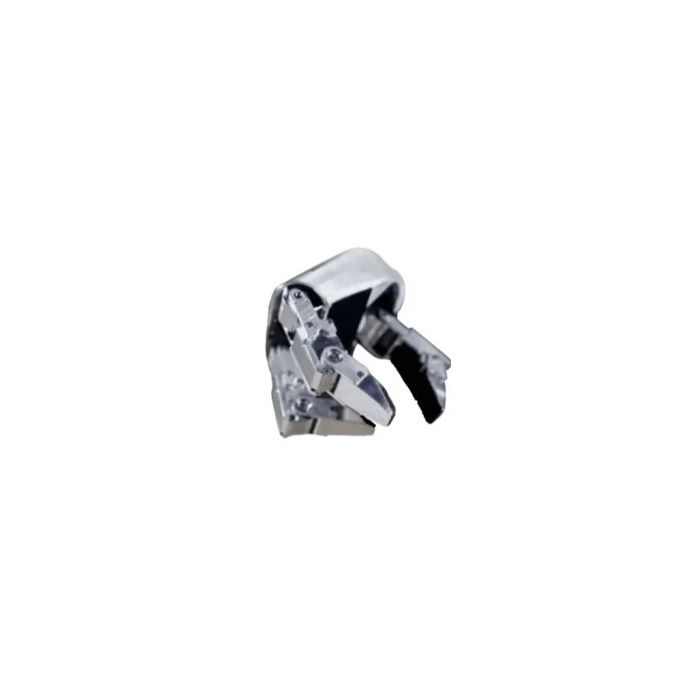
Unitree G1 Dex3-1 Force-Controlled 3-Finger Tactile Dexterous Hand
In stock
- BRAND:
- UNITREE ROBOTICS
- PART #:
- G1-DEX3-3FINGERHAND-TACTILE
- ORIGIN:
- China
- AVAILABILITY:
- ALLOW 2-4 WEEKS FOR DELIVERY
- SKU:
- Unitree-G1-DEX3-TACTILE-HAND
Unitree G1 Dex3-1 Force-Controlled 3-Finger Tactile Dexterous Hand
A humanoid robot can cross a laboratory floor with real composure and still fail the moment it reaches for a screwdriver. Walking makes the headlines, but manipulation decides whether the machine earns its place once it arrives. The Unitree G1 Dex3-1 Force-Controlled 3-Finger Tactile Dexterous Hand sits at that point of success or failure, on the end of the G1's arm. It turns a capable walking platform into one that handles objects through measured, sensed contact rather than blind closing of the fingers.
Robots Middle East supplies the Dex3-1 to universities, research institutes, system integrators and corporate innovation teams across the Middle East. Our team prepares each quotation, coordinates delivery to the customer's site and provides technical support after the hand is installed on the G1, so that the hand arrives as part of a working programme rather than as a loose component.
Background
Unitree Robotics and the G1 platform
Unitree Robotics built its reputation on legged robots and has since extended that expertise into humanoids. The G1 is its compact humanoid, aimed at research, education and development work, where teams need a full-body platform that can be programmed, modified and studied. In such a platform the hand is the end effector: the part that carries out the task the rest of the body has positioned it for. The Dex3-1 is Unitree's own three-finger answer to that requirement. It is designed to be used with the G1 humanoid robot to perform a variety of complex actions, and it is offered as an optional configuration on the G1 EDU.
Direct-drive joints and fingertip sensing
The Dex3-1 has seven degrees of freedom: three in the thumb, two in the index finger and two in the middle finger. Six of those joints are driven directly by micro brushless force control motors, and one uses a micro brushless force control joint with a gear drive. The hand uses the F-1515-108 and F-1515-214 miniature brushless force control joints. Direct drive keeps the mechanical path between motor and finger short, which suits force control. The hand also carries 33 tactile sensors, so the controller receives information about contact as well as joint position. Combined with force and position hybrid control, this sensing makes the hand sensitive and reliable.
Technical Specifications
| Specification | Value |
|---|---|
| Degrees of freedom | 7 (Thumb x 3, Index Finger x 2, Middle Finger x 2) |
| Transmission mechanism | 6 Motors Drive Directly, 1 Motor Drive with Gears |
| Joint motor models | F-1515-108 and F-1515-214 Miniature Brushless Force Control Joint |
| Control | Force and position hybrid control |
| Tactile sensors | 33 per hand |
| Number of pressure sensors | 9 (Total of 33 Pressure Sensors) |
| Range of perception | 10g-2500g |
| Maximum acceptance (undamaged) | 20kg |
| Fingertip repeat positioning accuracy | ±2mm |
| Load condition (palm facing down at room temperature, grasping a 5cm round hard object) | Maximum weight 500g; maximum power 400W@3s |
| Weight | 710g |
| Size | 175mm x 88mm x 77mm |
| Working voltage | 12~58V |
| Maximum current | 10A |
| Communication interface | USB2.0 |
| Communication rate | 1000Hz |
| Working temperature range | -20℃ ~ 60℃ |
| Compatibility | Unitree G1 humanoid robot; optional configuration on the G1 EDU |
Specifications are as published by the manufacturer and are confirmed against the datasheet at quotation. The manufacturer has not published the box contents, an IP rating for the hand, any weight difference between the left and right hands, or a grip force figure; these points are confirmed at quotation.
Why does force and position hybrid control matter in a robot hand?
A hand governed by position alone moves each finger to a target angle and stops there. That works when the object is exactly where the programme expects and exactly as rigid as assumed. When either assumption is wrong, the fingers either miss the object or press into it harder than intended. Force and position hybrid control lets the controller regulate both where the fingers are and how they interact with what they touch, which is the behaviour a grasp on an unfamiliar object requires.
The Dex3-1 supports that approach with hardware chosen for it. Six of its seven joints are driven directly by brushless force control motors, and the 33 tactile sensors report contact across a range of perception from 10g to 2500g. Data travels over USB2.0 at a communication rate of 1000Hz, giving control software a frequent view of what the hand is sensing. Combined with a fingertip repeat positioning accuracy of ±2mm, this gives researchers a hand on which grasp strategies can be tested, repeated and compared. The load condition is specific: with the palm facing down at room temperature, grasping a 5cm round hard object, the maximum weight is 500g. Buyers planning heavier handling should treat that figure as the reference point for their task design.
How does the Dex3-1 fit the G1 and the G1 EDU?
The Dex3-1 is supplied as left and right hands and is intended for the G1 humanoid. On the G1 EDU, the force-controlled three-fingered hand is an optional configuration that gives a single hand seven degrees of freedom. For teams ordering a new G1 EDU, this means the hand can form part of the robot specification from the outset. For teams that already operate a G1, the question is which configuration and side they require, and that is settled when the quotation is prepared.
Electrically, the hand works across a voltage range of 12~58V with a maximum current of 10A, and its working temperature range of -20℃ ~ 60℃ is relevant for facilities across the region where laboratories, exhibition halls and test areas vary in climate control. At 710g and 175mm x 88mm x 77mm, it is a compact unit for the end of a humanoid arm, which matters because every gram at the wrist affects the arm's dynamics.
Who is the Unitree G1 Dex3-1 Force-Controlled 3-Finger Tactile Dexterous Hand for?
The primary buyers are university laboratories and research institutes working on manipulation, tactile sensing and embodied artificial intelligence. For them, the combination of force control, tactile data and a well-documented humanoid platform makes the Dex3-1 a practical basis for experiments and publications. Engineering faculties that teach robotics will find it useful for showing students the gap between motion planning and physical contact.
System integrators and corporate research and development teams form a second group. They use the G1 with the Dex3-1 to evaluate whether humanoid manipulation can serve a particular task before committing to a larger programme. Innovation centres and technology showcases, which are increasingly common across the Gulf, form a third group, where a hand that handles objects convincingly makes a humanoid demonstration far more meaningful.
Buyers who are still comparing end effectors for Unitree humanoids can review the full range in the Hands category, and those assembling a complete G1 setup will find related items under Humanoid Accessories.
What is the Unitree G1 Dex3-1 Force-Controlled 3-Finger Tactile Dexterous Hand used for?
- Grasp research: testing and comparing grasp strategies on objects of different shape and stiffness.
- Tactile data collection: recording contact data from the hand's sensors to train and validate learning-based manipulation models.
- Teleoperation and demonstration learning: capturing human-guided manipulation sequences on the G1 for imitation learning work.
- Robotics education: giving students hands-on experience of force control, sensing and humanoid manipulation.
- Task feasibility studies: evaluating whether a humanoid can handle the light objects involved in a planned service or industrial task.
- Public demonstrations: showing visitors at innovation centres and exhibitions a humanoid that interacts with objects rather than simply moving.
Pricing and Availability
Robots Middle East supplies the Dex3-1 on quotation, so that each offer reflects the side or sides required, whether the hand is ordered with a new G1 EDU or for an existing G1, and the support the customer needs. Delivery, customs clearance and after-sales support are arranged together with the quotation. To begin, please share your intended application and current G1 configuration with our team; the quotation request for this hand is available on this page.
Frequently Asked Questions
Does the Dex3-1 work with the Unitree G1?
Yes. The hand is designed to be used with the G1 humanoid robot to perform complex actions, and it is offered as an optional configuration on the G1 EDU.
How many tactile sensors does the hand have?
Each hand carries 33 tactile sensors, with a range of perception of 10g-2500g.
Is the hand available for both left and right sides?
Yes, the Dex3-1 is supplied as left and right hands. Please state which side, or both, when requesting your quotation.
How does the hand communicate with the robot?
The hand uses a USB2.0 communication interface with a communication rate of 1000Hz.
What power does the hand require?
The working voltage is 12~58V and the maximum current is 10A.
In what temperatures can the hand operate?
The working temperature range is -20℃ ~ 60℃. Robots Middle East can advise on the suitability of a specific installation when preparing the quotation.
Where can I buy the Unitree G1 Dex3-1 Force-Controlled 3-Finger Tactile Dexterous Hand and what does it cost?
You can buy it from Robots Middle East, which supplies it across the Middle East. The cost depends on the configuration and support required, and it is provided in a quotation requested through this page.
Summary
A humanoid's worth is measured at the point where it touches the world, and the Dex3-1 is Unitree's tool for that moment. Seven degrees of freedom, direct-drive brushless force control joints, 33 tactile sensors and force and position hybrid control give the G1 a hand that senses contact and adjusts to it. Its figures, from the ±2mm fingertip repeat positioning accuracy to the 500g load condition, give researchers and integrators a clear basis for planning. For organisations across the Middle East ready to move their G1 from motion to manipulation, with quotation, delivery and support from Robots Middle East, this page is the starting point.
Specifications
General
What's included
Related Products
Out of stock