
Unitree Z1 Air Robot Arm (Z1-AIR)
In stock
- BRAND:
- UNITREE ROBOTICS
- PART #:
- Z1-AIR
- ORIGIN:
- China
- AVAILABILITY:
- SUBJECT TO AVAILABILITY
- SKU:
- Unitree-Z1-AIR
Unitree Z1 Air Robot Arm (Z1-AIR)
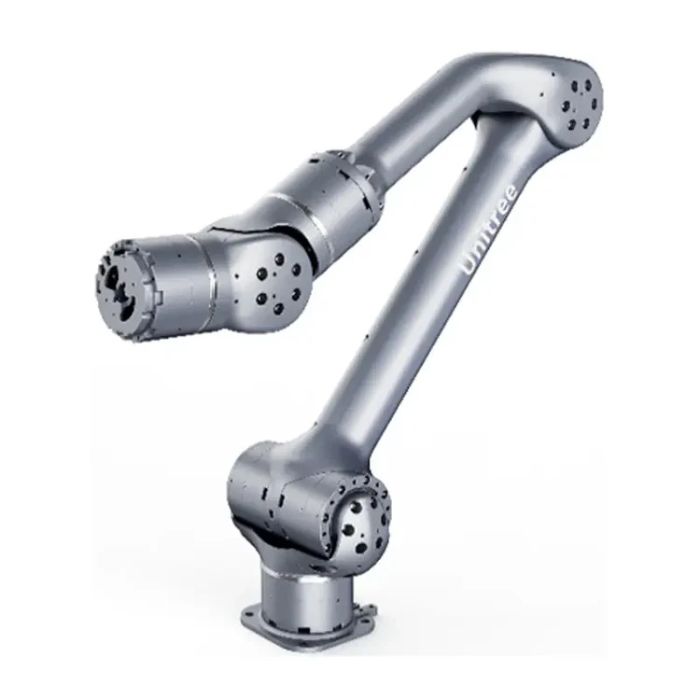
A thousand times every second, each joint motor in this arm receives a fresh instruction on where to be and how firmly to push. That rhythm sits at the heart of the Unitree Z1 Air Robot Arm (Z1-AIR), a six-axis manipulator that pairs position and force control with harmonic reducers and 15bit encoders, yet weighs only 4.3kg. Integrators know the usual trade-off: fine control tends to arrive with bulk, and portability tends to cost precision. The Z1 Air is designed to offer the first without the second, and to leave its software and its wrist open to whatever a project demands next.
Robots Middle East supplies the Unitree Z1 Air Robot Arm (Z1-AIR) to universities, research laboratories, system integrators and commercial operators across the Middle East. Our team prepares each quotation around the buyer's intended configuration, arranges delivery into the region and remains the point of contact for technical support after installation, so that the arm arrives ready for integration rather than simply ready to be unpacked.
Background
Unitree Robotics and its move into manipulation
Unitree Robotics built its reputation on legged machines, chiefly quadruped robots and, more recently, humanoids. Platforms of that kind can walk, climb and carry sensors, but they cannot handle objects without an arm. The Z1 family is the company's answer to that gap: a line of compact manipulators that can work on a bench, inside a cell or mounted on a mobile base. The sources name two versions, the Z1 AIR and the Z1 PRO, and this page concerns the Z1 AIR alone. Every figure quoted below belongs to that version.
Joint design: harmonic reduction and force control
Much of what distinguishes the Z1 Air lies inside its joints. Each joint motor delivers a maximum torque of 33N·m, weighs 405g and measures Φ65*52mm. Motion passes through a harmonic reducer, a gearing type widely chosen in robotics for its compactness and low backlash, while a 15bit encoder reports the joint's position. The joint motors run at a control frequency of 1KHz, and the arm accepts both position and force control. Force control matters wherever an arm must touch the world gently: pressing, inserting, guiding or sharing space with people, rather than simply moving from one coordinate to the next.
Technical Specifications
| Specification | Value |
|---|---|
| Degrees of freedom | 6 Axis |
| Weight | 4.3kg |
| Payload | 2kg |
| Reach | 740mm |
| Repeatability | ~0.1mm |
| Power supply | Voltage 24V, Current > 20A |
| Power | MAX 500w |
| Interface | Ethernet |
| User operating system | Ubuntu |
| Control interface | Position + Force Control |
| Joint 1 range / max speed | ±150° / 180°/s |
| Joint 2 range / max speed | 0-180° / 180°/s |
| Joint 4 range / max speed | ±80° / 180°/s |
| Joint 5 range / max speed | ±85° / 180°/s |
| Joint 6 range / max speed | ±160° / 180°/s |
| Joint motor maximum torque | 33N·m |
| Joint motor weight | 405g |
| Joint motor size | Φ65*52mm |
| Control frequency | 1KHz |
| Reducer | Harmonic Reducer |
| Encoder resolution | 15bit |
Specifications are given as the manufacturer publishes them and are confirmed against the datasheet at quotation.
The manufacturer has not published the dimensions of the arm, its IP rating, its operating temperature range, SDK or ROS details on its product page, the contents of the box or the maximum end-effector speed; Robots Middle East confirms these at quotation.
What makes the Z1 Air suited to mobile robot integration?
An arm destined for a mobile base must respect three budgets: mass, power and communication. On mass, the Z1 Air weighs 4.3kg, light enough to be considered for platforms where every component on the chassis affects endurance and stability. On power, it runs from a 24V supply with a current above 20A and a maximum draw of 500w, a profile that can be planned into a robot's electrical architecture from the outset. On communication, it connects over Ethernet and is driven from Ubuntu, which places it within the Linux environment that most robotics research teams already use.
The manufacturer explicitly lists mobile robot on-board arms among the intended uses, alongside e-commerce logistics, new consumption and daily-life scenarios. It also describes the arm as having an open programme interface and an expansion interface, with the control programme and control interface being opened successively. For an integrator, that openness is as important as any mechanical figure: it determines whether the arm can be coordinated with the base's navigation, perception and task planning, rather than operating as an isolated device.
Can the Z1 Air change tools between tasks?
Yes. Different actuators can be quickly replaced at the end of the manipulator, so the same arm can move from one end tool to another as the work changes. In practice, this lets a laboratory test several grasping strategies on one platform, or allows a logistics prototype to switch between handling methods without rebuilding the cell. When choosing a tool, buyers should remember that its weight counts against the 2kg payload, and that the exact interface at the wrist is best confirmed with Robots Middle East before ordering.
Who is the Unitree Z1 Air Robot Arm (Z1-AIR) for?
The Z1 Air serves several distinct groups. University departments and research institutes will value its force control, open interfaces and Ubuntu environment for work in manipulation, learning-based control and human-robot interaction. Teams that build or modify mobile robots, including those working with Unitree quadrupeds, will find its weight and Ethernet connection practical for on-board integration; related mounting and add-on hardware is gathered under Quadruped Accessories. System integrators developing proof-of-concept cells for e-commerce logistics or retail can use it to validate handling concepts before committing to larger industrial equipment.
Where the tooling is heavier, or the task calls for more payload margin than 2kg allows, the Unitree Z1 Pro Robot Arm (Z1-Pro) is the sibling to compare, and it is also offered as the Unitree Z1 Pro Robot Arm with Z1 Gripper for buyers who want an end tool included. Teams that need replacement or development joints can look at the Unitree Z1 Motor, and the full family can be compared in the Unitree Arms category.
What is the Unitree Z1 Air Robot Arm (Z1-AIR) used for?
- Mobile manipulation: mounted on a mobile robot to give it the ability to reach, grasp and interact.
- Research and teaching: a platform for experiments in motion planning, force control and robot learning.
- E-commerce logistics: prototyping picking and handling steps within fulfilment workflows.
- New consumption: service and retail concepts in which a robot handles goods in view of customers.
- Daily-life assistance: developing household and assistive tasks that require gentle, controlled contact.
- Tool development: testing custom end-effectors through the quick-change actuator end.
Pricing and Availability
Robots Middle East supplies the Z1 Air on quotation, so that the offer reflects the configuration, end tools and integration support each project actually requires. Delivery, customs clearance and after-sales support are arranged together with the quotation. Tell us about the intended platform and application, and our team will confirm the outstanding specifications against the datasheet before you commit. The request form for your quotation is available on this page.
Frequently Asked Questions
How many axes does the Z1 Air have?
The Z1 Air is a six-axis arm, with published ranges and maximum speeds for joints 1, 2, 4, 5 and 6.
What payload and reach does the Z1 Air offer?
It carries a payload of 2kg and has a reach of 740mm, with repeatability of ~0.1mm.
Which operating system and connection does it use?
The user operating system is Ubuntu, and the arm connects over Ethernet.
Does the arm support force control?
Yes. Its control interface offers both position and force control, with the joint motors running at a control frequency of 1KHz.
What power supply does it require?
It requires a 24V supply with a current above 20A, and its maximum power is 500w.
Is ROS supported?
The manufacturer's product page does not publish SDK or ROS details. Robots Middle East confirms the current software support at quotation.
Where can I buy the Unitree Z1 Air Robot Arm (Z1-AIR) and what does it cost?
You can buy it from Robots Middle East, which supplies it across the Middle East. The cost depends on your configuration and is provided in a personal quotation that you can request from this page.
Summary
The Unitree Z1 Air Robot Arm (Z1-AIR) is built around a simple but demanding idea: that a thousand-times-a-second control loop, harmonic reducers and force control need not come in a heavy package. At 4.3kg, with a 2kg payload, a 740mm reach and ~0.1mm repeatability, it suits the bench, the logistics prototype and the mobile robot alike, while its quick-change end and progressively opened interfaces let it grow with the project. Robots Middle East quotes, delivers and supports it across the region, and for anyone weighing it against the Z1 Pro or planning a mobile manipulation build, this page is the starting point.
Specifications
General
What's included
Related Products
Out of stock