
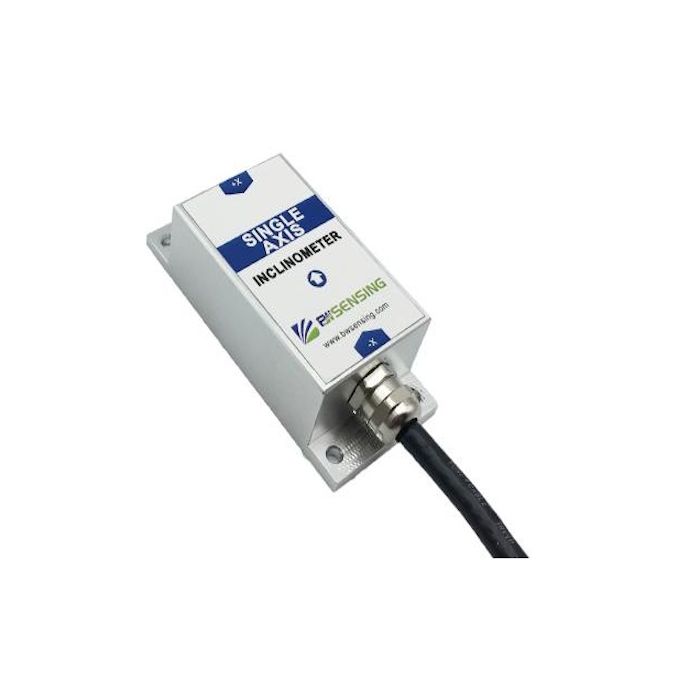
BWSENSING Inclinometer (BWK218)
In stock
- BRAND:
- BWSENSING
- PART #:
- BWK218
- ORIGIN:
- China
- AVAILABILITY:
- SUBJECT TO AVAILABILITY
- SKU:
- BWSENSING-BWK218
BWSENSING Inclinometer (BWK218)
On a solar field at midday, or on the boom of a crane at a busy quay, an angle sensor does its work far from the control room and in conditions no laboratory would choose. The BWSENSING Inclinometer (BWK218) is built for that distance. It is a single-axis tilt sensor that measures inclination across ±180° and sends the result down the line as an industrial current signal, from an IP67 housing rated to work between -40℃ and +85℃. It does not ask the controller to learn a new protocol. It simply reports, continuously, how far the structure it is fixed to has moved from its reference.
Robots Middle East supplies the BWK218 to system integrators, plant operators, equipment builders and engineering contractors across the Middle East. Robots Middle East prepares each quotation, advises on the output range and configuration that suit your controller, and arranges delivery and after-sales support for projects throughout the region. Whether you need a single unit for a trial or a quantity for a tracker installation, our team will guide you from specification to commissioning.
Background
Bewis Sensing Technology and the BWSENSING range
The BWK218 is designed by Bewis Sensing Technology LLC and sold under the BWSENSING brand, which covers a broad family of inclinometers and attitude sensors. Within the BWSensing range, the models differ mainly in the number of axes they measure and in how they deliver their reading: some speak digital protocols such as Modbus or CAN, others offer dual-axis measurement. The BWK218 occupies a deliberately simple position in that line-up. The manufacturer describes it as a low cost, current output, single-axis inclinometer, intended for engineers who want one angle, delivered as one dependable analogue signal.
An industrial MEMS accelerometer behind a current loop
At the heart of the BWK218 is an industrial-level MEMS accelerometer. Inclinometers of this class work by sensing the direction of gravity: when the housing tilts, the share of gravity acting along the measuring axis changes, and the electronics convert that change into an angle. The BWK218 then expresses the angle as a current, selectable as 4-20mA, 0-20mA or 0-24mA. Current signals are long established in industrial automation because they are read in the same way by programmable logic controllers, data loggers and panel indicators, and because a current loop tolerates long cable runs and electrically noisy surroundings better than a plain voltage signal. The design brings together a solid-state sensing element and an output that almost any control cabinet can accept.
Technical Specifications
| Specification | Value |
|---|---|
| Product type | Current output low cost single-axis inclinometer, industrial level MEMS accelerometer |
| Measuring range | ±180° |
| Highest accuracy | 0.2° |
| Resolution | 0.02° |
| Output | 4-20mA / 0-20mA / 0-24mA optional |
| Zero-point current output | 10 (0-20); 12 (4-20); 12 (0-24) |
| Power supply | 12-36V |
| Working temperature | -40℃~+85℃ |
| Protection level | IP67 |
| Impact resistance | 2000g, 0.5ms, 3 times/axis |
| EMC | According to GBT17626 |
| Dimensions | L90*W40.5*H26 (mm) |
| Weight | 230 (without package) |
Specifications are as published by the manufacturer and are confirmed against the datasheet at quotation.
The manufacturer has not published the cable length, the zero temperature drift, the non-linearity, the output noise density or the contents of the box; Robots Middle East confirms these at quotation.
Why choose a current-output inclinometer rather than a digital one?
A digital inclinometer can carry more information over a single cable, including diagnostics and addressing for several sensors on one bus. That is a real advantage in a new installation designed around a fieldbus. Many working plants, however, are built around analogue inputs, and adding a protocol means configuring a gateway, assigning addresses and training staff on a new tool. The BWK218 removes that step. Its angle arrives as a current that an existing analogue input card can scale directly into degrees.
The specification supports this role well. A supply range of 12-36V suits the voltages commonly found in industrial control panels, the IP67 protection level allows the sensor to sit outside the cabinet on the structure itself, and an impact resistance of 2000g, 0.5ms, 3 times/axis indicates a sensor intended for machinery rather than for the bench. Electromagnetic compatibility is specified according to GBT17626, which matters where the sensor shares cable trays with drives and converters. For projects that do need a bus, the BWSENSING family offers alternatives, discussed further below.
Which output range should you specify: 4-20mA, 0-20mA or 0-24mA?
The three output options are not merely a matter of preference; each places the zero point differently. The manufacturer gives the zero-point current as 12 on the 4-20mA range, 10 on the 0-20mA range and 12 on the 0-24mA range. In each case the level reference sits within the span, so tilt in either direction is represented on both sides of it.
The 4-20mA option is the usual choice for new installations. Because the signal never falls to zero during normal operation, a controller can treat a reading near zero current as a broken wire or a lost supply rather than as a valid angle. The 0-20mA and 0-24mA options help where an existing input card or legacy system is already scaled to those ranges, avoiding the need to reconfigure the controller. Robots Middle East helps you select the appropriate range when preparing the quotation, so the sensor arrives matched to the equipment it will connect to.
Who is the BWSENSING Inclinometer (BWK218) for?
The BWK218 is aimed at engineers who need a single angle reported reliably to an analogue input. Solar developers and EPC contractors fitting photovoltaic trackers are an obvious group, since tracker controllers need to know the position of each row. Builders and operators of lifting equipment use inclination control to keep booms and platforms within safe limits. Telecommunications and utility companies monitoring towers and masts need early warning of any lean. Oil drilling contractors, manufacturers of special valves and industrial converters, and designers of medical instruments complete the list of applications named by the manufacturer.
Some buyers will be better served by a sibling model. If your structure must be monitored on two axes at once, look at the BWSENSING Cost-Effective Dual-Axis Inclinometer (BWM427). If your control system communicates over Modbus, the BWSENSING Cost-Effective Single-Axis Digital Output With Modbus Inclinometer (BWM417) keeps single-axis measurement while joining the bus, and vehicle or machine builders working with CAN networks may prefer the BWSENSING Cost-Effective Single-Axis CAN Output Inclinometer (BWM415). The wider choice of tilt and motion devices is collected in our Sensors category.
What is the BWSENSING Inclinometer (BWK218) used for?
- Industrial automatic levelling – feeding a platform or machine bed's angle to the controller that brings it back to level.
- Photovoltaic automatic tracking – reporting each tracker row's tilt so panels follow the sun accurately.
- Tower tilt monitoring – watching masts and towers continuously for any lean that calls for inspection.
- Lifting equipment inclination control – keeping cranes, booms and aerial platforms within their permitted working angles.
- Oil drilling equipment – providing inclination feedback on rigs and associated machinery in demanding field conditions.
- Medical instruments and special valves – supplying a single, stable angle reading to precision equipment and valve actuators.
Pricing and Availability
Robots Middle East supplies the BWK218 by quotation, so that the output range, quantity and project requirements can be agreed before you commit. Tell us about your application, the controller you are connecting to and the number of units you need, and we will prepare a quotation tailored to your project. Delivery, customs clearance and technical support are arranged together with the quotation. To begin, request your quotation through the enquiry form available on this page.
Frequently Asked Questions
What does the BWK218 measure?
The BWK218 measures inclination on a single axis, across a range of ±180°. It uses an industrial-level MEMS accelerometer to sense tilt relative to gravity.
Which output signals are available?
The output can be specified as 4-20mA, 0-20mA or 0-24mA. The zero-point current is 12 on the 4-20mA range, 10 on the 0-20mA range and 12 on the 0-24mA range.
What power supply does the sensor need?
The BWK218 operates from a 12-36V supply, which suits the voltages commonly available in industrial control panels.
Can the BWK218 be installed outdoors?
The sensor carries an IP67 protection level and a working temperature range of -40℃~+85℃. It also withstands impacts of 2000g, 0.5ms, 3 times/axis.
How accurate is the BWK218?
Its highest accuracy is 0.2° and its resolution is 0.02°. Robots Middle East can help you judge whether this suits your application before you order.
How large is the BWK218?
The housing measures L90*W40.5*H26 (mm), and the weight is given as 230 (without package). Its compact form allows it to be fitted directly to the structure being monitored.
Where can I buy the BWSENSING Inclinometer (BWK218) and what does it cost?
You can buy the BWK218 from Robots Middle East, which supplies it across the Middle East. Cost depends on configuration and quantity, so please request a quotation through this page.
Summary
The BWSENSING Inclinometer (BWK218) is designed for the places where angles matter most and conditions are least forgiving: the tracker row in the sun, the crane boom, the tower on the skyline. It answers with a single-axis reading over ±180°, a highest accuracy of 0.2° and a resolution of 0.02°, delivered as a 4-20mA, 0-20mA or 0-24mA current that existing controllers accept without a new protocol. An IP67 housing, a working temperature range of -40℃~+85℃ and substantial impact resistance make it at home on working equipment. Where a project needs two axes or a digital bus, the wider BWSENSING family offers an alternative. For a quotation from Robots Middle East, with delivery and support arranged, this page is the starting point.