
Galileo EX-1 Intelligent Bionic Explosion-Proof Quadruped Robot
In stock
- BRAND:
- GALILEO
- MODEL:
- EX-1
- ORIGIN:
- China
- Warranty:
- 12 MONTHS
- AVAILABILITY:
- SUBJECT TO AVAILABILITY
- SKU:
- GALILEO-EX-1
Galileo EX-1 Intelligent Bionic Explosion-Proof Quadruped Robot
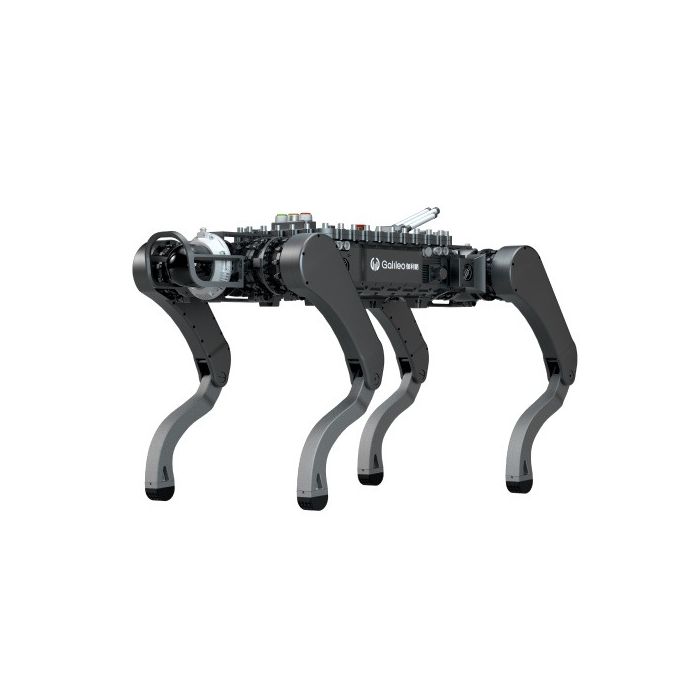
On a refinery, the hazardous-area drawing decides what may cross each line on the plot plan. Long before a technician picks up a gas detector, that drawing has already excluded most ordinary electrical equipment, which is why so much routine inspection still depends on people walking into zones they would rather observe from outside. The Galileo EX-1 Intelligent Bionic Explosion-Proof Quadruped Robot approaches the problem from the opposite direction: it carries an explosion-proof marking of its own, walks on legs rather than rolling on wheels, and can be steered over 5G/4G while the operator remains beyond the boundary of the classified area.
Robots Middle East sells the Galileo EX-1 and supplies it to petrochemical operators, emergency services and industrial contractors throughout the Middle East. Our team prepares each quotation against your site requirements, coordinates delivery to your facility and remains your point of contact for technical support once the robot is in service.
Background
Galileo (Tianjin) Technology Co., Ltd.
The EX-1 is developed by Galileo (Tianjin) Technology Co., Ltd., a company established in 2021 and headquartered in Tianjin. In a short period the company has built a family of legged robots, which also includes the Galileo S1 Large Industrial Grade Quadruped Robot Dog and the Galileo E1 Quadruped Robot Dog. Within that family, the EX-1 is the model whose design brief is framed explicitly around high-risk environments such as emergency rescue and petrochemical operations, with the stated aim of removing people from hazardous scenarios altogether.
A bionic walker built around explosion protection
The term bionic refers to the way the EX-1 moves: like an animal, it distributes its weight across legs and joints rather than relying on a fixed chassis. The robot has 12 degrees of freedom in total, driven by high stiffness, high power density permanent magnet synchronous motors with a maximum joint torque of 500Nm. Perception comes from a single lidar and dual depth cameras, which support autonomous navigation as well as remote operation. What distinguishes the platform is that this mobility is packaged within an explosion-proof rating of Ex ⅡB T4 Gb and an IP66 protection rating, so that the walking machine and its enclosure are conceived together rather than as a standard robot with protection added afterwards.
Technical Specifications
| Specification | Value |
|---|---|
| Explosion-proof rating | Ex ⅡB T4 Gb |
| Protection rating | IP66 |
| Standing dimensions (L x W x H) | 1300*650*790mm |
| Weight with battery | 120kg |
| Total degrees of freedom | 12 |
| Joint motor type | High Stiffness High Power Density Permanent Magnet Synchronous Motor |
| Maximum joint torque | 500Nm |
| Battery | 48V lithium battery, 45.2Ah (2160Wh) |
| Endurance time | 2h |
| Continuous walking load | 30kg |
| Movement speed | 1.0m/s |
| Slope climbing capability | 30° |
| Stair walking capability | 25cm steps |
| Obstacle crossing ability | 25cm |
| Ditch crossing width | 30cm |
| Perception sensors | Lidar*1; dual depth cameras |
| Remote control | 5G/4G remote control |
| Supported payloads | Dual-light PTZ, methane gas detection sensor, voice intercom module, speaker |
| External interface | Ethernet |
| Software | Autonomous navigation; secondary development supported |
| Standard accessories | Charger; explosion-proof tablet controller |
Specifications are as published by the manufacturer and are confirmed against the datasheet at quotation.
The manufacturer has not published the folded dimensions, the battery charging time, the wireless remote-control range, the ingress rating of the tablet controller or the certification number; these details are confirmed at quotation.
What does the Ex ⅡB T4 Gb rating mean for a petrochemical site?
An explosion-proof marking is a compact statement that a site safety engineer reads against the area classification of the facility. In the familiar gas-atmosphere schemes, the elements of the code describe the type of protection, the gas group the equipment is designed for, its temperature class and its equipment protection level. For the EX-1, that statement is Ex ⅡB T4 Gb, and it is the first figure most hazardous-area teams will check before considering anything else on the specification sheet.
The practical consequence is that the conversation about deployment begins with your own zone drawings. Your safety engineer compares the gases present in each area and the classification of each zone with the rating the robot carries, and from that comparison decides where the EX-1 may walk. The IP66 protection rating addresses a separate concern: dust and water, including the wash-down, rain and sand that outdoor plants in the region routinely face. Robots Middle East will work alongside your safety engineer through this review before any order is placed.
Why choose a legged robot over a wheeled or tracked inspection platform?
Process plants are rarely designed with robots in mind. Walkways cross pipe racks, platforms are reached by stairs, drainage channels interrupt the ground and bunded areas are surrounded by kerbs. Wheeled and tracked platforms are very effective on prepared surfaces, but every step and gap tends to require either a ramp or a change of route. A legged robot instead treats the plant largely as a person would.
The EX-1 climbs stairs with 25cm steps, crosses obstacles of 25cm and ditches 30cm wide, and handles slopes of 30°, all while carrying a continuous walking load of 30kg at a movement speed of 1.0m/s. Its lidar and dual depth cameras give it the awareness required to place its feet and to navigate autonomously along a defined route. For an operator, this means that an inspection round can follow the paths that technicians already use, rather than being limited to the sections of the site that happen to be flat.
Who is the Galileo EX-1 for?
The first and most obvious group is petrochemical operators: refineries, gas processing plants, tank farms and chemical facilities where explosive atmospheres are part of daily operations and where routine rounds expose staff to risk. For these organisations, the EX-1 offers a way to repeat inspection routes with a methane gas detection sensor and a dual-light PTZ while personnel remain outside the classified area.
The second group is emergency and rescue services. After a leak, fire or structural incident, the most dangerous moment is often the initial assessment, when nobody yet knows what the atmosphere contains. A robot that can be sent forward under 5G/4G control, report gas readings and relay voice through its intercom module and speaker allows commanders to make decisions on the basis of evidence rather than assumption.
The third group comprises system integrators, industrial safety contractors and research teams. Support for secondary development, autonomous navigation and an Ethernet external interface make the EX-1 a platform on which customised inspection workflows can be built. Organisations whose sites contain no explosive atmosphere may find that a different model in the Galileo range is more appropriate, and our team will gladly discuss the options during the quotation process.
What is the Galileo EX-1 used for?
- Routine inspection rounds: walking repeatable routes through process units so that technicians spend less time in hazardous zones.
- Methane leak detection: carrying the methane gas detection sensor to suspected leak points and reporting readings remotely.
- Visual surveillance: using the dual-light PTZ to observe equipment, valves and pipework from a safe operating position.
- Emergency reconnaissance: entering an incident area ahead of responders to assess conditions before people are committed.
- Remote communication: relaying instructions or reassurance to people on scene through the voice intercom module and speaker.
- Custom application development: building site-specific inspection tasks through secondary development and the Ethernet interface.
Pricing and Availability
The Galileo EX-1 is offered on a quotation basis, as the final configuration depends on the payloads, accessories and certification documentation your project requires. Please send us your intended application, the area classification of your site and the payloads you need, and Robots Middle East will prepare a tailored proposal. Delivery, customs clearance and after-sales support are arranged together with the quotation. To begin, a request for quotation is available on this page.
Frequently Asked Questions
What explosion-proof rating does the Galileo EX-1 carry?
The EX-1 carries an explosion-proof rating of Ex ⅡB T4 Gb and a protection rating of IP66. Your safety engineer compares this rating with the classification of each zone on your site.
How long does the robot operate on a single charge?
Its 48V lithium battery, rated at 45.2Ah (2160Wh), provides an endurance time of 2h under standard conditions. A charger is supplied as standard.
What can the EX-1 carry?
It has a continuous walking load of 30kg and supports a dual-light PTZ, a methane gas detection sensor, a voice intercom module and a speaker. A charger and an explosion-proof tablet controller are supplied as standard.
Can the robot be operated from a safe distance?
Yes, the EX-1 supports 5G/4G remote control through its explosion-proof tablet controller, as well as autonomous navigation, so that operators can work in separated human-machine scenarios.
Can the EX-1 climb stairs and cross rough ground?
It walks stairs with 25cm steps, crosses obstacles of 25cm and ditches 30cm wide, and climbs slopes of 30°.
Can the EX-1 be integrated with our own systems?
Secondary development is supported, and the robot provides an Ethernet external interface for connecting additional systems. Our team can discuss your integration requirements during the quotation process.
Where can I buy the Galileo EX-1 and what does it cost?
You can buy the Galileo EX-1 from Robots Middle East, which supplies it across the Middle East. The cost depends on the configuration and payloads you select, and it is set out in a quotation prepared for your project.
Summary
Hazardous-area drawings were written to keep ignition sources out, and for decades that has meant keeping most machines out as well, leaving people to carry out the inspection work. The Galileo EX-1 changes that balance. With an Ex ⅡB T4 Gb rating, IP66 protection, legs that manage stairs, obstacles and ditches, and payloads for gas detection, observation and voice communication, it is designed to cross the lines on the plot plan that operators would rather not cross themselves. For petrochemical sites, rescue services and integrators across the region considering a safer approach to hazardous inspection, this page is the starting point.