
Galileo E1 Quadruped Robot Dog
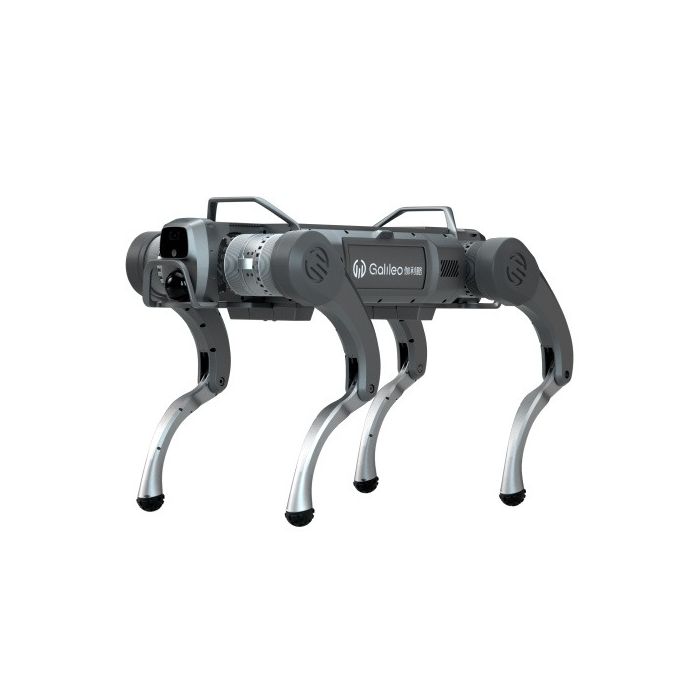
In stock
- BRAND:
- GALILEO
- MODEL:
- E1
- ORIGIN:
- China
- Warranty:
- 12 MONTHS
- AVAILABILITY:
- SUBJECT TO AVAILABILITY
- SKU:
- GALILEO-E1
Galileo E1 Quadruped Robot Dog
Most of a field robot's working life is spent waiting. Between scheduled inspection rounds, between alarms and between the call-outs that justified the purchase, a machine sits in a cabinet or on a dock while its battery quietly drains. The Galileo E1 Quadruped Robot Dog treats that idle time as part of the job. In low-power mode it holds for at least 365 days and can be woken remotely. When the call comes, it rises on four legs with a 1440Wh lithium battery, an IP67-rated body and a dual-processor control system behind it. It is a medium industrial-grade platform designed to be left on site and trusted to answer.
Robots Middle East supplies the Galileo E1 to industrial operators, utilities, security integrators, emergency services and research institutions across the Middle East, including the GCC states. Robots Middle East prepares the quotation, arranges delivery to the project site and supports the robot after commissioning, so that a single point of contact handles configuration questions from the first enquiry through to day-to-day operation.
Background
Galileo (Tianjin) Technology and the E1 Series
Galileo (Tianjin) Technology Co., Ltd. was established in 2021 and is headquartered in Tianjin. In a short period the company has built a family of legged robots that covers several sizes and duties. The range carried by Robots Middle East runs from a small quadruped through the medium E1 Series to a large industrial-grade model, with wheeled variants and an explosion-proof design alongside. The E1 Series is a medium industrial-grade line, which places it between compact platforms intended for lighter tasks and the heavier machines built for the most demanding payloads. The series comes in two versions: the E1 described on this page and the wheeled E1-W.
Two processors and an open body
The E1's control system pairs a domestic ARM low-power, high-performance CPU (8 cores, 8 threads, 8GB RAM, 64GB SSD) with an X86 low-power, high-performance CPU (4 cores, 8 threads, 16GB RAM, 256GB HDD). In legged robotics, an arrangement of this kind is commonly used to separate locomotion control from heavier computing work, such as mapping or analysing data from mission payloads, so that one does not starve the other. The body is designed to accept equipment. It provides Ethernet, USB and TypeC communication interfaces, together with 48V and 24V power outputs, and both the communication and power interfaces can be expanded as needed. The E1 can be equipped with customised devices to tackle harsh conditions, including toxic-hazardous and high-risk environments, and an app is supported for operation.
Technical Specifications
| Specification | Value |
|---|---|
| Product class | E1 Series - Medium Industrial Grade |
| Standing dimensions (L x W x H) | 1000*452*550mm |
| Weight | 52kg |
| Battery type | Lithium Battery |
| Battery capacity | 30Ah(1440Wh) |
| Battery rated voltage | 48V |
| Movement speed | 0-3.5m/s (Adjustable) |
| Slope climbing capability | ≥30° |
| Climbable height | Forward height difference 80cm platform |
| Endurance time | 2.5-4.5h |
| Range | >16km |
| Continuous walking load | 30kg |
| Maximum load | 100kg (Standing load) |
| Protection rating | IP67 |
| Operating temperature | -20℃~55℃ |
| External communication interface | Ethernet; USB; TypeC (Interface expandable as needed) |
| External power interface | 48V; 24V (Expandable as needed) |
| Low power mode | ≥365 days, supports remote wake-up |
| Autonomous charging | Supported |
| Control system CPU | Domestic ARM low-power high-performance CPU (8 cores 8 threads / 8GB RAM / 64GB SSD) + X86 low-power high-performance CPU (4 cores 8 threads / 16GB RAM / 256GB HDD) |
| App | Supported |
Specifications are as published by the manufacturer and are confirmed against the datasheet at quotation.
The manufacturer has not published the sensor and camera fit, the folded dimensions, the charging time, the included accessories, the operating system or SDK, the noise level or the degrees of freedom; Robots Middle East confirms these at quotation.
What does a year-long standby mean for remote sites?
Many inspection and security tasks are intermittent rather than continuous. A pumping station may need a check after a pressure alarm, a remote compound may need a patrol only when a perimeter sensor trips, and a warehouse may need a walk-through outside working hours. For tasks like these, the limiting factor is often not how long the robot can walk but whether it is ready when needed. The E1 addresses this directly. Its low-power mode lasts at least 365 days and supports remote wake-up, so the robot can be stationed on site and brought into service without someone travelling out to switch it on.
Once active, the E1 offers an endurance time of 2.5 to 4.5 hours and a range of more than 16km, with movement speed adjustable from 0 to 3.5m/s. Autonomous charging is supported, which matters for unattended deployments. A robot that can return to charge on its own can be scheduled for repeated rounds rather than single missions, turning a one-off asset into a standing part of the site's routine.
Can the Galileo E1 cope with heat, dust and wet conditions?
The region's operating conditions are hard on equipment, so the E1's environmental figures are worth reading closely. Its IP67 rating denotes a dust-tight enclosure with protection against temporary immersion in water. This suits sand-laden outdoor sites as well as washdown areas and coastal facilities. The rated operating temperature runs from -20℃ to 55℃. That upper bound covers a wide span of conditions, but on exposed sites in high summer, project teams will want to plan mission timing around it, favouring early-morning, evening or night rounds for outdoor work.
Terrain is the other half of the environmental picture. The E1 climbs slopes of 30° or more and can step onto a platform with a forward height difference of 80cm. This lets it work on embankments, ramps, raised walkways and cluttered plant floors where a wheeled platform would struggle.
Who is the Galileo E1 Quadruped Robot Dog for?
The E1 is aimed at organisations that need a legged robot for real field work rather than demonstrations. Utilities and industrial operators will value the IP67 body, the long standby and the autonomous charging for recurring inspection rounds. Security integrators can use the expandable interfaces to fit their own payloads for patrol duties. Emergency services and civil-defence teams gain a platform that can carry customised devices into toxic-hazardous and high-risk settings; the wider selection for that sector is gathered in our Emergency Response category. Universities and research laboratories will find the dual-processor architecture and open interfaces a practical base for development work.
Some buyers will be better served by a sibling model. Where long stretches of paved or smooth ground dominate the route, the wheeled Galileo E1-W Wheeled Quadruped Robot Dog is worth comparing. Teams looking for a lighter, more compact machine should consider the Galileo C1 Small Quadruped Robot Dog. Those with heavier industrial demands can look at the Galileo S1 Large Industrial Grade Quadruped Robot Dog. For work in potentially explosive atmospheres, where certified equipment is required, the Galileo EX-1 Intelligent Bionic Explosion-Proof Quadruped Robot is the appropriate choice rather than the E1.
What is the Galileo E1 used for?
- Utility and substation inspection: recurring rounds at remote sites, with the robot woken remotely and returning to charge without staff on hand.
- Perimeter and facility security: patrols of compounds, depots and campuses with integrator-supplied cameras or sensors mounted on the body.
- Industrial plant rounds: walking the floors, gantries and ramps of plants in non-classified areas to record conditions.
- Emergency reconnaissance: carrying customised devices into toxic-hazardous or high-risk areas before responders enter.
- Infrastructure and tunnel surveys: covering long linear routes where range and slope climbing count for more than speed.
- Research and development: serving as a legged test platform for navigation, perception and payload integration projects.
Pricing and Availability
Robots Middle East supplies the Galileo E1 on a quotation basis, so that the configuration, payload interfaces and support package match the project rather than a generic listing. Delivery, customs clearance and after-sales support are arranged together with the quotation. To begin, please send your requirements and site conditions through the quotation request available on this page.
Frequently Asked Questions
How long does the Galileo E1 operate on one charge?
The E1 has an endurance time of 2.5 to 4.5 hours and a range of more than 16km.
Is the Galileo E1 suitable for outdoor use in dusty or wet conditions?
Yes. The E1 carries an IP67 protection rating and has an operating temperature range of -20℃ to 55℃.
How much can the Galileo E1 carry?
The continuous walking load is 30kg and the maximum standing load is 100kg. Payloads intended to travel with the robot should be planned against the walking figure.
Can the Galileo E1 charge itself?
Yes, autonomous charging is supported. This allows the robot to be scheduled for repeated unattended rounds.
Can I integrate my own sensors and devices?
Yes. The E1 provides Ethernet, USB and TypeC communication interfaces and 48V and 24V power outputs, all expandable as needed, which gives integrators room to fit their own payloads.
What is the difference between the E1 and the E1-W?
The E1 is the legged version of the medium industrial-grade series, and the E1-W is the wheeled version. The E1-W has its own product page with its own figures.
Where can I buy the Galileo E1 Quadruped Robot Dog and what does it cost?
Robots Middle East supplies the Galileo E1 across the Middle East. Pricing depends on configuration, payloads and support requirements, so it is provided in a formal quotation requested from this page.
Summary
The Galileo E1 is built for organisations that need a robot ready to work on demand, not one that must be fetched, charged and prepared every time it is needed. Its key features make it a platform that can be stationed on site and called on when the situation requires:
- a standby of at least a year with remote wake-up
- autonomous charging
- an IP67 body
- slope and platform climbing
- expandable power and data interfaces
Robots Middle East supplies, delivers and supports it across the region. For a robot that waits patiently and then gets on with the job, this page is the starting point.