
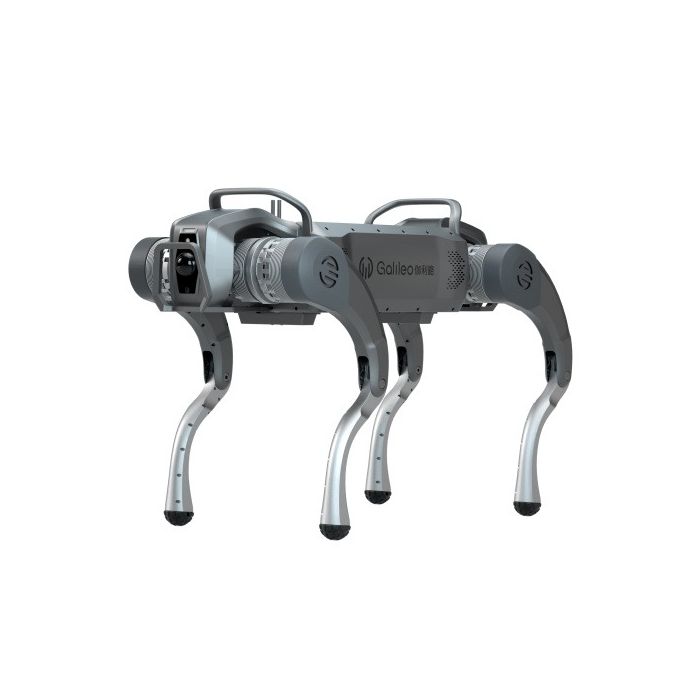
Galileo S1 Large Industrial Grade Quadruped Robot Dog
In stock
- BRAND:
- GALILEO
- MODEL:
- S1
- ORIGIN:
- China
- Warranty:
- 12 MONTHS
- AVAILABILITY:
- SUBJECT TO AVAILABILITY
- SKU:
- GALILEO-S1
Galileo S1 Large Industrial Grade Quadruped Robot Dog
Some of the most valuable hours a rescue or inspection robot spends are the ones in which it does nothing at all: parked in a depot, waiting for the call. The Galileo S1 Large Industrial Grade Quadruped Robot Dog is built for both halves of that life. It has a low-power mode rated at ≥365 days with remote wake-up. Once roused, it is a four-legged body that walks under a 100kg load, climbs 30cm consecutive steps and works from -20℃ to 55℃ behind an IP67 rating. It is a large machine for heavy work, designed to be ready when that work arrives.
Robots Middle East sells and supplies the Galileo S1 to organisations across the Middle East, including industrial operators, utilities, logistics teams, civil defence units and research groups. Robots Middle East prepares each quotation around the intended application, arranges delivery to site and provides support after commissioning. Payloads, interfaces and the charging arrangement are therefore agreed before the robot is shipped.
Background
Galileo and its quadruped family
Galileo builds a family of legged robots that runs from compact quadrupeds through wheeled-leg variants to an explosion-proof model. The S1 Series sits at the heavy end of that family. The manufacturer describes the Galileo Intelligent Bionic Quadruped Robot S1 Series as a heavy-duty, large-scale bionic robot for demanding professional scenarios. It names four of them: industrial inspection, plateau material transportation, large-equipment mounted inspection and emergency rescue. Within the series, the S1 is the legged version presented on this page, and the S1-W is its wheeled counterpart.
Bionic quadrupeds take their layout from four-legged animals because legs can choose where they land. A wheeled or tracked vehicle has to deal with the whole surface beneath it. A legged robot needs only a series of footholds, which is why this class of machine is chosen for stairways, rubble, uneven yards and steep ground.
Positioning and key technology
The S1 is positioned as a working platform rather than a demonstrator. Its control system pairs two processors. The first is a domestic ARM low-power high-performance CPU with 8 cores, 8 threads, 8GB RAM and a 64GB SSD. The second is an X86 low-power high-performance CPU with 4 cores, 8 threads, 16GB RAM and a 256GB HDD. Dual-architecture control of this kind is commonly used in field robotics to keep locomotion and housekeeping tasks apart from heavier computing work such as perception or mission software.
Around that core sit the features that make long deployments practical: dual lithium batteries, autonomous charging, WIFI6 dual-band wireless, app control and customisable payload interfaces for inspection sensors, transport bins and rescue equipment.
Technical Specifications
| Specification | Value |
|---|---|
| Standing dimensions (L x W x H) | 1200x550x650mm |
| Weight | 118kg |
| Battery capacity | 60Ah(3540Wh, Dual Batteries) |
| Battery type | Lithium Battery |
| Battery rated voltage | 59V |
| Charger input | 100V~240V |
| External power interface | 48V;24V(Expandable as needed) |
| External communication interface | Ethernet; USB3.0; RS485(Interface expandable as needed) |
| Low power mode | ≥365 days, supports remote wake-up |
| Autonomous charging | Supported |
| Movement speed | 0-3.5m/s(Adjustable) |
| Maximum climbable slope | ≥30° |
| Climbable height | 30cm high consecutive steps, Forward height difference 80cm platform |
| Endurance time | 3.5-5h |
| Continuous walking load | 100kg |
| Maximum standing load | 170kg |
| CPU | Domestic ARM low-power high-performance CPU (8 cores 8 threads / 8GB RAM / 64GB SSD) + X86 low-power high-performance CPU (4 cores 8 threads / 16GB RAM / 256GB HDD) |
| WIFI6 dual-band wireless | Supported |
| APP | Supported |
| Protection rating | IP67 |
| Operating environment temperature | -20℃~55℃ |
| Payload interfaces | Customisable, for inspection sensors, transport bins and rescue equipment |
The specifications above are as the manufacturer publishes them and are confirmed against the datasheet at quotation.
The manufacturer has not published the fitted sensors, the camera and lidar specifications, the contents of the box, the number of joint degrees of freedom, the noise level, the charging time or the software and SDK compatibility; each of these is confirmed at quotation.
What makes the Galileo S1 different from smaller quadruped robots?
The first difference is load. The S1 walks continuously with 100kg on its back and stands under a maximum of 170kg. For a machine weighing 118kg, it can carry close to its own weight on the move. This is what turns a legged robot from a camera carrier into a means of transport. On a plateau supply route or at a rescue site, it means tools, water, medical kits or sensor packages can travel on the robot rather than on people.
The second difference is ground. The S1 climbs slopes of ≥30°, takes 30cm high consecutive steps and handles a forward height difference of 80cm onto a platform. Those figures describe staircases, loading docks and broken terrain, the places where carts and trolleys stop.
The third difference is endurance in the widest sense. Dual batteries with a combined 60Ah (3540Wh) give an endurance time of 3.5-5h. Autonomous charging lets the robot return to its supply without an operator, and the low-power mode of ≥365 days with remote wake-up allows it to stand by for long periods without servicing. The IP67 rating and the -20℃ to 55℃ operating range mean that dust, heavy rain and summer heat are within its stated working conditions.
How does the Galileo S1 integrate with existing equipment?
A heavy-duty platform is only as useful as what it can carry and talk to. The S1 provides external power at 48V and 24V, expandable as needed, so mounted devices draw from the robot's own supply. For data, it offers Ethernet, USB3.0 and RS485, again expandable as needed. That covers most industrial cameras, gas detectors, controllers and recorders. WIFI6 dual-band wireless and app support provide the link to the operator.
The customisable payload interfaces are intended for exactly the equipment its scenarios require: inspection sensors, transport bins and rescue equipment. Because the fitted sensors and the software and SDK compatibility are not published, Robots Middle East confirms the mounting, power budget and integration route for each payload as part of the quotation.
Who is the Galileo S1 for?
The S1 suits organisations whose robots must carry real weight across difficult ground. Industrial operators in oil and gas, power generation, petrochemicals and heavy manufacturing can use it as a mobile inspection base around large plant. Mining and infrastructure teams working at altitude can use it for plateau material transportation. Civil defence and emergency services can keep it on standby for rescue work, since the low-power mode and remote wake-up suit a robot that waits long between call-outs. Research institutions studying heavy-payload legged locomotion will find its open interfaces useful.
Where a site offers long, flat stretches between obstacles, the wheeled sibling, the Large Industrial Grade Wheeled Quadruped Robot Dog, deserves a look; its own specification sheet sets out how it differs. Where the work takes place in potentially explosive atmospheres, the Galileo EX-1 Intelligent Bionic Explosion-Proof Quadruped Robot is the relevant model. Lighter tasks may be served by the Galileo C1 Small Quadruped Robot Dog. Buyers comparing platforms can browse Standard Quadrupeds or the wider Emergency Response range.
What is the Galileo S1 used for?
- Industrial inspection — patrolling plant, pipe racks and substations with mounted inspection sensors.
- Plateau material transportation — carrying supplies and equipment across high, steep or roadless ground.
- Large-equipment mounted inspection — serving as a mobile base for inspection devices around large machinery and structures.
- Emergency rescue — bringing rescue equipment into areas that are unsafe or impassable for responders.
- Standby deployment — waiting in low-power mode at remote sites until it is woken remotely for a task.
- Payload research and development — testing sensors and tools through its power and communication interfaces.
Pricing and Availability
Robots Middle East supplies the Galileo S1 on quotation, prepared around your application, payloads and site conditions. Delivery, customs clearance and after-sales support are arranged with the quotation. The unpublished items, from fitted sensors to charging time and software compatibility, are confirmed in writing at the same stage. To begin, request a quotation for the Galileo S1 Large Industrial Grade Quadruped Robot Dog, available on this page.
Frequently Asked Questions
How much can the Galileo S1 carry?
The S1 has a continuous walking load of 100kg and a maximum standing load of 170kg.
How long does the Galileo S1 operate on one charge?
Its endurance time is 3.5-5h from dual lithium batteries totalling 60Ah (3540Wh). Autonomous charging is supported, so the robot can return to charge without an operator.
Can the Galileo S1 work outdoors in heat, dust and rain?
The S1 carries an IP67 protection rating and an operating environment temperature of -20℃~55℃.
Which sensors and cameras are fitted to the Galileo S1?
The manufacturer has not published the fitted sensors or the camera and lidar specifications. Robots Middle East confirms the sensor configuration with the quotation.
Can I mount my own equipment on the Galileo S1?
Yes. The S1 has customisable payload interfaces, external power at 48V and 24V, and Ethernet, USB3.0 and RS485 connections, all expandable as needed.
What is the difference between the S1 and the S1-W?
The S1 is the legged version of the S1 Series and the S1-W is the wheeled version. Each has its own specification sheet, and Robots Middle East can advise which suits your site.
Where can I buy the Galileo S1 Large Industrial Grade Quadruped Robot Dog and what does it cost?
You can buy it from Robots Middle East, which supplies it across the Middle East. The cost depends on configuration and payloads and is set out in a quotation that you can request on this page.
Summary
The Galileo S1 is built for a working life of long waits and hard shifts. It can sit in low-power mode for ≥365 days and wake on a remote command. It then walks under 100kg, climbs steps, slopes and platforms, tolerates rain, dust and heat behind its IP67 rating, and returns to charge on its own. Its dual-processor control system and open power and data interfaces make it a carrier for the sensors, bins and rescue equipment each mission calls for. For organisations that need a heavy legged robot ready for inspection, transport or rescue, with Robots Middle East handling quotation, delivery and support, this page is the starting point.