
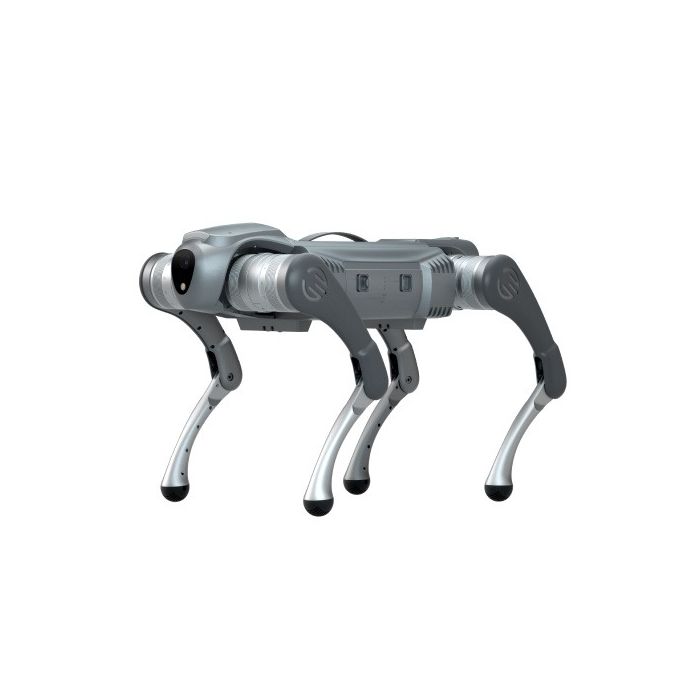
Galileo C1 Small Quadruped Robot Dog
In stock
- BRAND:
- GALILEO
- MODEL:
- C1
- ORIGIN:
- China
- AVAILABILITY:
- SUBJECT TO AVAILABILITY
- SKU:
- GALILEO-C1
Galileo C1 Small Quadruped Robot Dog
Most of a working robot's life is spent waiting: parked beside a cabinet, idle between patrols, or shelved in a laboratory until the next experiment. The Galileo C1 Small Quadruped Robot Dog is built with that in mind. It can rest in a low power mode for at least 365 days and be woken remotely. When its battery runs low, it can return to a charger on its own. Then it walks off on four legs over stairs and slopes that would stop a wheeled trolley. For a research group, a teaching laboratory or a team responsible for small industrial equipment, that pairing of patience and agility is the real proposition.
Robots Middle East supplies the Galileo C1 to universities, research institutes, system integrators and industrial operators across the Middle East, including the United Arab Emirates, Saudi Arabia, Qatar, Kuwait, Bahrain and Oman. Robots Middle East prepares each quotation around the intended application and agrees the configuration with the manufacturer. It also arranges delivery, customs clearance and after-sales support for customers throughout the region.
Background
Galileo and the C1 Series
Galileo produces a family of bionic quadruped robots. The range spans compact legged machines, wheeled-leg variants and larger industrial platforms such as the Galileo S1 Large Industrial Grade Quadruped Robot Dog. The C1 Series sits at the small, lightweight end of that family. The manufacturer describes it as a lightweight and versatile bionic robot tailored for consumer-grade scenarios, scientific research and education, and inspection of small industrial equipment. The series currently comprises two versions: the legged C1 described on this page, and the C1-W. That positioning matters. The C1 is not intended to be a heavy industrial workhorse. It is a platform that can be carried, studied, programmed and deployed by small teams without dedicated handling equipment.
Dual-mode energy management
The technology that most clearly defines the C1 is the way it manages its energy. The manufacturer calls this dual-mode energy management: autonomous charging, combined with manual battery replacement. In practice, the robot can top itself up between tasks without an operator. Where a project cannot wait for a charge cycle, a technician can exchange the battery by hand instead. The 48V lithium battery has a capacity of 20Ah (960Wh) and gives an endurance time of 3-5h. A low power mode of at least 365 days with remote wake-up allows the robot to be left on standby for long periods and called into action when needed. For remote or rarely visited installations, this changes how a legged robot can be scheduled.
Technical Specifications
| Specification | Value |
|---|---|
| Standing dimensions (L x W x H) | 765x410x475mm |
| Weight | 22kg |
| Continuous load | 12kg |
| Movement speed | 0-3m/s (Adjustable) |
| Maximum climbable slope gradient | ≥30° |
| Stair walking capability | ≥20cm high consecutive steps |
| Battery type | Lithium Battery |
| Battery capacity | 20Ah (960Wh) |
| Battery rated voltage | 48V |
| Charger input | 100V~240V |
| Endurance time | 3-5h |
| Low power mode | ≥365 days, supports remote wake-up |
| Autonomous charging function | Supported |
| Energy management | Dual-mode: autonomous charging + manual battery replacement |
| Control system CPU | Domestic ARM low-power high-performance CPU (8 cores 8 threads / 8GB RAM / 64GB SSD) |
| Secondary development | Supported |
| WIFI6 dual-band wireless | Supported |
| External power interface | 48V; 24V (Expandable as needed) |
| External communication interface | Ethernet; USB; RS485 (Interface expandable as needed) |
| Front camera | Wide-angle, resolution 1920*1080 |
| Joint IP rating | IP67 |
| Operating environment temperature | -20℃~55℃ |
Specifications are as published by the manufacturer and are confirmed against the datasheet at quotation.
The manufacturer has not published the maximum rated payload, the battery charge time, the number of degrees of freedom, whether a LiDAR option is offered, what is in the box, whether a controller or remote is included, the noise level, any mobile app, or the operating system and SDK; Robots Middle East confirms these at quotation.
How does the Galileo C1 cope with stairs, slopes and demanding conditions?
Legs are the reason to choose a quadruped over a wheeled base, and the C1 puts them to use. It climbs consecutive steps of at least 20cm and handles slopes of at least 30°. This means it can move between floors of a laboratory building, up a plant-room staircase or along a ramped service route without being carried. Its movement speed is adjustable from 0 to 3m/s. Operators can therefore slow it to a careful walk around sensitive equipment or let it cover open ground more quickly.
The environmental figures are equally relevant in the Gulf. The C1 is specified for operation from -20℃ to 55℃, a range that covers air-conditioned interiors and a good part of the outdoor conditions found across the region. Its joints carry an IP67 rating, which protects the moving parts that matter most in a walking robot from dust and water. At 22kg with a standing footprint of 765x410x475mm, it remains small enough for two people to lift into a vehicle and light enough to work in confined spaces.
Can the Galileo C1 be developed and expanded for a specific project?
The C1 is designed as a platform rather than a closed appliance. Secondary development is supported, and the control system runs on a domestic ARM low-power high-performance CPU with 8 cores and 8 threads, 8GB of RAM and a 64GB SSD. This gives researchers and integrators onboard computing capacity for their own software. Connectivity covers WIFI6 dual-band wireless together with Ethernet, USB and RS485, and the communication interface can be expanded as needed.
Power for added equipment is available through external 48V and 24V interfaces, which are also expandable. Combined with a continuous load of 12kg, this lets a project team mount additional sensors, instruments or a small payload and power it directly from the robot. The front wide-angle camera at 1920*1080 provides a starting point for vision work. Robots Middle East can discuss mounting, integration and the development environment with the manufacturer as part of the quotation.
Who is the Galileo C1 for?
University departments and research institutes are the most natural buyers. They need a legged platform that students and researchers can program, modify and test without the space and safety arrangements a larger industrial robot requires. Those comparing it with other platforms for laboratory work will find related systems in our Research Robots category. Educators running robotics, mechatronics or artificial intelligence courses will value a robot that combines open development with real locomotion.
Operators responsible for small industrial equipment form the second group. These include plant rooms, compact substations, utility cabinets and technical facilities where a robot can walk a regular route and look at equipment through its camera. The long standby mode and autonomous charging suit sites that are visited only occasionally. System integrators building custom solutions on a legged base make up a third group, drawn by the expandable power and communication interfaces.
Where a site favours rolling over smooth, flat floors, the wheeled Galileo C1-W Wheeled Quadruped Robot Dog is the sibling worth comparing. Buyers looking at other walking platforms can browse the Standard Quadrupeds category. Robots Middle East is happy to set the options side by side for a specific application.
What is the Galileo C1 used for?
- Locomotion research: studying legged movement, balance and gait control on a compact, programmable platform.
- Robotics education: giving students hands-on experience with a real quadruped in teaching laboratories.
- Small equipment inspection: walking routine routes around compact industrial installations and recording what the camera sees.
- Long-standby monitoring: remaining in low power mode at a remote location until it is woken for a task.
- Vision and perception development: building and testing software on the front wide-angle camera and onboard computer.
- Innovation showcases: demonstrating bionic robotics in consumer-grade settings such as exhibitions and innovation centres.
Pricing and Availability
Robots Middle East supplies the Galileo C1 on a quotation basis. This lets the configuration, interfaces and any integration work be matched to your project before an order is placed. Delivery, customs and support are arranged with the quotation, so the arrangements for your country are clear from the outset. To begin, please share your intended application, the number of units required and your delivery location. A quotation request form for the Galileo C1 Small Quadruped Robot Dog is available on this page.
Frequently Asked Questions
Can the Galileo C1 charge itself?
Yes. Autonomous charging is supported, and the C1 also allows manual battery replacement, so the two modes can be combined to suit your operating schedule.
How long does the Galileo C1 operate on one battery?
The endurance time is 3-5h from its 20Ah (960Wh) lithium battery. In low power mode it can remain on standby for at least 365 days and be woken remotely.
Is the Galileo C1 protected against dust and water?
The joints carry an IP67 rating, which protects the moving parts of the legs against dust and water.
Can I develop my own software for the Galileo C1?
Secondary development is supported, and the robot provides an 8-core ARM CPU with 8GB of RAM and a 64GB SSD. Robots Middle East is glad to discuss your development plans in detail.
How much can the Galileo C1 carry?
The C1 has a continuous load of 12kg, and its external 48V and 24V power interfaces can supply mounted equipment.
Will the Galileo C1 work in Middle Eastern conditions?
The operating environment temperature is -20℃ to 55℃. For prolonged outdoor work in summer, Robots Middle East can advise on scheduling and site conditions during the quotation.
Where can I buy the Galileo C1 and what does it cost?
You can buy the Galileo C1 from Robots Middle East, which supplies customers across the Middle East. Pricing depends on configuration and project requirements and is provided in a formal quotation requested through this page.
Summary
A robot that spends most of its time waiting needs to wait well, and then move well when it is called. The Galileo C1 does both. It offers a low power mode of at least 365 days with remote wake-up, autonomous charging alongside manual battery replacement, and four legs that climb steps and slopes. It adds IP67-rated joints, an operating range of -20℃ to 55℃, an 8-core onboard computer, expandable power and communication interfaces, and support for secondary development. Together these make it a capable platform for research, education and the inspection of small industrial equipment. Robots Middle East handles the configuration, delivery, customs and support across the region. For any team ready to put a compact legged robot to work, this page is the starting point.