
Galileo C1-W Wheeled Quadruped Robot Dog
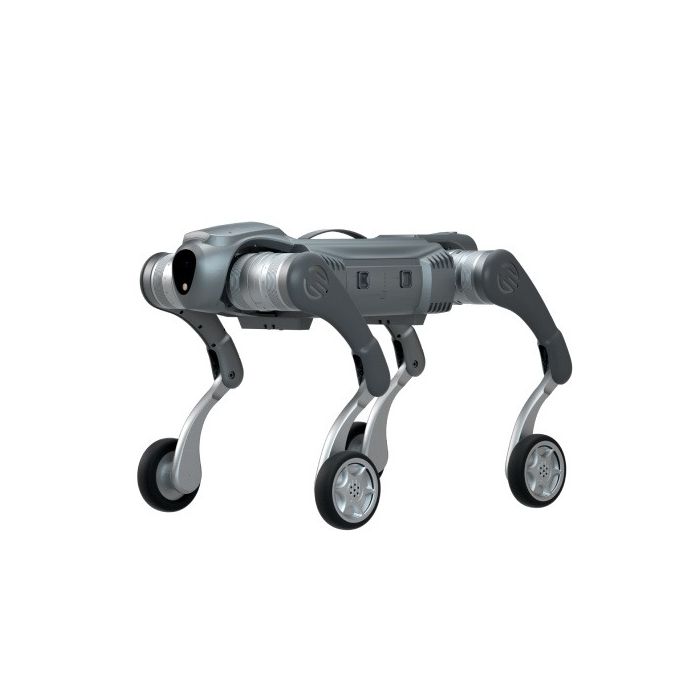
In stock
- BRAND:
- GALILEO
- MODEL:
- C1-W
- ORIGIN:
- China
- AVAILABILITY:
- SUBJECT TO AVAILABILITY
- SKU:
- GALILEO-C1-W
Galileo C1-W Wheeled Quadruped Robot Dog
Most field robots are judged by how they move, yet much of their working life is spent waiting: between patrol shifts, between semesters, between the seasonal inspections of a plant that runs quietly for months. The Galileo C1-W Wheeled Quadruped Robot Dog is built for both halves of that life. Awake, it rolls on wheeled feet and steps with articulated legs, taking open floor, slopes, stairs and narrow spaces in one outing. Dormant, it can hold a low-power mode for at least 365 days and be woken remotely when the next task arrives.
Robots Middle East supplies the Galileo C1-W across the Middle East, working with universities, research laboratories, integrators and industrial operators. Robots Middle East prepares each quotation, coordinates delivery to the customer's site and remains the point of contact for support after the robot is commissioned.
Background
The Galileo range and the C1 Series
Galileo offers a family of quadruped platforms that runs from compact research and education machines to large industrial-grade robots and a dedicated ground mobility platform. Within that range, the C1 Series occupies the compact end. The series comprises two versions: the legged Galileo C1 Small Quadruped Robot Dog and the C1-W described here, which adds wheels to the same compact quadruped concept. Larger members of the family, such as the Large Industrial Grade Wheeled Quadruped Robot Dog, address heavier industrial duty, while the C1-W is aimed at consumer-grade scenarios, scientific research and education, and light-duty industrial inspection.
Wheel-leg hybrid mobility
The C1-W uses a compact bionic quadruped structure with wheel-leg hybrid mobility and a 16-degree-of-freedom design. In practical terms, the robot can travel efficiently on wheels where the ground allows, then use its legs where wheels alone would fail: on inclines, on consecutive steps and through confined passages. It switches between these motion modes to suit flat ground, slopes, stairs and narrow spaces. This places the C1-W among the Wheeled Quadrupeds, a class of robot that combines the travel efficiency of a wheeled vehicle with the terrain reach of a walking machine. Onboard, a domestic ARM low-power, high-performance CPU handles control, supported by autonomous navigation and obstacle avoidance.
Technical Specifications
| Specification | Value |
|---|---|
| Standing dimensions (L x W x H) | 765x480x540mm |
| Weight | 28.5kg |
| Degrees of freedom | 16 |
| Structure | Compact bionic quadruped with wheel-leg hybrid mobility |
| Movement speed | 0-5m/s (Adjustable) |
| Maximum climbable slope | ≥30° |
| Stair walking capability | ≥20cm high consecutive steps |
| Continuous load | 12kg |
| Endurance time | 3-5h |
| Low power mode | ≥365 days, supports remote wake-up |
| Battery type | Lithium Battery |
| Battery capacity | 20Ah(960Wh) |
| Battery rated voltage | 48V |
| Charger input | 100V~240V |
| Autonomous charging | Supported |
| External power interface | 48V;24V (Expandable as needed) |
| External communication interface | Ethernet; USB; RS485 (Interface expandable as needed) |
| Wireless | WIFI6 Dual-band Wireless Supported |
| Control system CPU | Domestic ARM low-power high-performance CPU (8 cores 8 threads / 8GB RAM / 64GB SSD) |
| Front camera | 1920 × 1080 front wide-angle camera with fill light |
| Navigation | Autonomous navigation and obstacle avoidance |
| Control modes | Manual remote control, autonomous inspection, intelligent follow |
| Joint IP rating | IP67 |
| Operating temperature | -20℃~55℃ |
| Secondary development | Supported |
Specifications are as published by the manufacturer and are confirmed against the datasheet at quotation.
The manufacturer has not published the battery recharge time, a maximum payload beyond the continuous walking load, a full camera specification on its own product page, a LiDAR option, the contents of the box, mobile app compatibility or the noise level; Robots Middle East confirms these points at quotation.
What does the wheel-leg design change in practice?
A purely legged robot spends energy on every step, even across a smooth corridor. A purely wheeled robot is quick on that corridor but stops at the first staircase. The C1-W is designed so that the operator does not have to accept either limitation. On level ground it can move at an adjustable speed of up to 5m/s; when the route turns upwards, it can climb slopes of at least 30° and walk consecutive steps of at least 20cm. Because it changes motion mode to match the surface, a single deployment can cover a mixed environment, such as a laboratory building, a light industrial site or a campus, without the route being redesigned around the machine.
The compact footprint matters as much as the speed. At 765x480x540mm standing and 28.5kg, the C1-W is sized for corridors, plant rooms and the narrow spaces where larger industrial quadrupeds would be awkward. Even so, it carries a continuous walking load of 12kg, which leaves room for sensors, instruments or small payloads mounted through its expandable 48V and 24V power interface and its Ethernet, USB and RS485 connections.
How long can the Galileo C1-W stay in service between charges?
In active use, the C1-W runs for 3-5h on its 48V lithium battery of 20Ah(960Wh). For routine work, autonomous charging is supported, so the robot can return to charge as part of its operating cycle rather than relying on a technician to plug it in. Between deployments, the low-power mode holds for at least 365 days and supports remote wake-up, which suits sites where the robot is needed intermittently. Joints rated IP67 and an operating temperature range of -20℃~55℃ broaden the conditions in which it can work, a relevant consideration for facilities across the region where heat is part of the daily environment.
Who is the Galileo C1-W Wheeled Quadruped Robot Dog for?
The first audience is research and education. Universities, technical colleges and laboratories working on locomotion, autonomy and embodied intelligence will find a platform that supports secondary development, carries an eight-core ARM control computer and exposes standard interfaces for additional hardware. It sits naturally alongside other Research Robots used for teaching and experimentation.
The second audience is light-duty industrial inspection. Facility operators and integrators who need a robot to patrol, observe and report in buildings with stairs, ramps and tight passages can use the autonomous inspection mode, the front wide-angle camera with fill light and the autonomous navigation and obstacle avoidance functions as the basis of an inspection routine.
The third audience is consumer-grade and demonstration projects: innovation centres, exhibitions and technology showcases where the intelligent follow mode and the visible versatility of wheels and legs together make the robot an engaging presence. Buyers whose sites are mainly level, or who are specifically interested in walking locomotion, may also wish to compare the C1-W with the legged C1 in the same series; Robots Middle East can advise on which version better suits a given programme.
What is the Galileo C1-W used for?
- Locomotion research — studying how a wheel-leg hybrid switches between rolling and walking across mixed terrain.
- Robotics teaching — giving students a programmable quadruped that supports secondary development.
- Indoor facility inspection — patrolling plant rooms, corridors and stairwells in autonomous inspection mode.
- Low-light observation — capturing visual information with the front wide-angle camera and fill light.
- Sensor and payload integration — mounting additional equipment on the expandable power and communication interfaces.
- Demonstrations and showcases — presenting intelligent follow and wheel-leg mobility at exhibitions and innovation centres.
Pricing and Availability
The Galileo C1-W is supplied by quotation, so that each offer reflects the intended application, any additional equipment and the destination country. Delivery, customs clearance and after-sales support are arranged together with the quotation. To begin, please submit your requirements through the quotation request available on this page.
Frequently Asked Questions
Can the Galileo C1-W climb stairs?
Yes. The C1-W walks consecutive steps of at least 20cm in height and climbs slopes of at least 30°.
How fast does the Galileo C1-W move?
Its movement speed is adjustable from 0 to 5m/s, which allows careful operation indoors and quicker travel over open ground.
Which control modes are available?
The robot supports manual remote control, autonomous inspection and intelligent follow, together with autonomous navigation and obstacle avoidance.
Can it charge itself?
Yes, autonomous charging is supported, so the robot can return to charge as part of its routine operating cycle.
Can I develop my own software for it?
Secondary development is supported, and the control system runs on a domestic ARM CPU with 8 cores, 8 threads, 8GB RAM and a 64GB SSD.
Is the Galileo C1-W suitable for hot environments?
Its operating temperature range is -20℃~55℃ and its joints are rated IP67; Robots Middle East can discuss your specific site conditions when preparing the quotation.
Where can I buy the Galileo C1-W Wheeled Quadruped Robot Dog and what does it cost?
The Galileo C1-W is available from Robots Middle East by quotation. Please submit a request through this page, and the offer will be prepared for your configuration and delivery location.
Summary
The Galileo C1-W is a robot designed for the whole of its working life, not only the moments when it is moving. Active, it combines wheels and legs to cross level floors quickly and then handle slopes, stairs and narrow spaces, guided by autonomous navigation and an onboard ARM computer. Idle, it can rest in low-power mode for a year or more and be woken remotely, and in routine service it can return to charge on its own. For research groups, educators and operators of light industrial sites who need that balance of reach, endurance and openness to development, this page is the starting point.