
Galileo E1-W Wheeled Quadruped Robot Dog
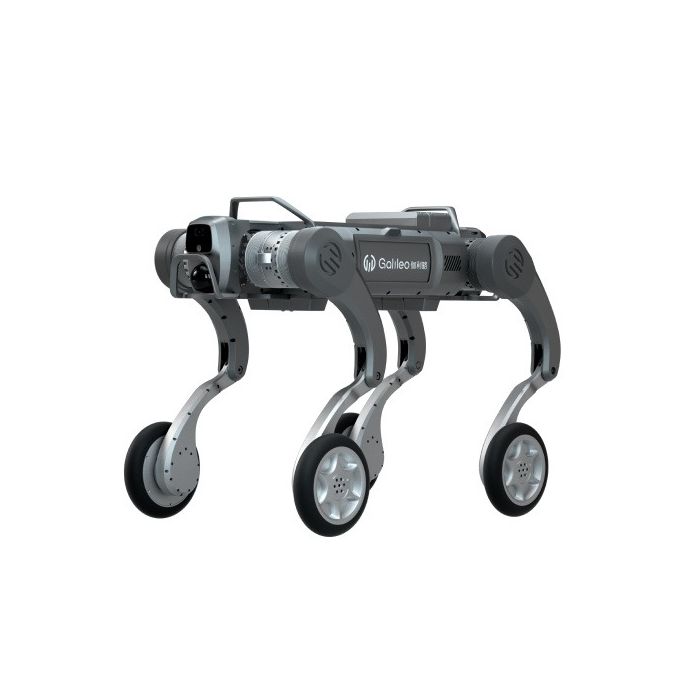
In stock
- BRAND:
- GALILEO
- MODEL:
- E1-W
- ORIGIN:
- China
- Warranty:
- 12 MONTHS
- AVAILABILITY:
- SUBJECT TO AVAILABILITY
- SKU:
- GALILEO-E1-W
Galileo E1-W Wheeled Quadruped Robot Dog
Picture a robot parked in its charging bay at a remote pumping station, idle for months, then woken from a control room the moment an alarm is raised. Within minutes it must cross a yard, take a flight of stairs and reach a raised platform before an engineer has even left the office. The Galileo E1-W Wheeled Quadruped Robot Dog is built for exactly that rhythm of long waiting and sudden effort. It offers a low power mode of ≥365 days with remote wake-up, autonomous charging, a movement speed of 0-6m/s (adjustable) and a wheel-leg integrated structure that climbs onto a platform with a forward height difference of 100cm.
Robots Middle East supplies the Galileo E1-W to organisations across the Middle East, including industrial operators, utilities, security services, emergency responders and universities. Robots Middle East prepares each quotation around the configuration a project requires, arranges delivery to site and supports the robot once it is in service. Procurement and engineering teams therefore work with a single partner from first evaluation to daily operation.
Background
Galileo and the E1 series
The E1-W belongs to Galileo's E1 series, which the manufacturer presents as a family of intelligent bionic robots. The sources name two versions: the E1 and the E1-W, the latter being the wheel-legged member of the series. The whole series supports secondary development, which tells buyers how Galileo expects these machines to be used. They are platforms for operators and integrators to build on, rather than closed appliances. Quadruped robots of this class have moved from laboratories into plants, campuses and public infrastructure over recent years. Their main users are teams that need eyes and sensors in places that are dangerous, repetitive or simply too remote to staff around the clock.
The wheel-leg integrated structure
The defining technology of the E1-W is its wheel-leg integrated structural design. The robot is not a wheeled vehicle with legs added, nor a walking robot with wheels attached. Wheels and legs are designed as one system. The platform has 16 degrees of freedom, which allows complex posture adjustments and fine movements. It also delivers 200Nm of joint torque, giving it the power to take on stairs, mountain tracks and gravel roads. For perception, the standard configuration places two LiDARs and two HD cameras at the front and rear. These work in coordination to give 360° all-round environmental perception and capture fine detail along the route.
Technical Specifications
| Specification | Value |
|---|---|
| Structure | Wheel-leg integrated structural design |
| Standing dimensions (L x W x H) | 995*537*630mm |
| Weight | 60kg |
| Degrees of freedom | 16 |
| Joint torque | 200Nm |
| Movement speed | 0-6m/s (Adjustable) |
| Slope climbing capability | ≥30° |
| Climbable height | Forward height difference 100cm platform |
| Continuous walking load | 30kg |
| Maximum load | 100kg (Standing load) |
| Range | >15km |
| Endurance time | 2.5-4h |
| Battery capacity | 30Ah (1440Wh) |
| Battery rated voltage | 48V |
| Low power mode | ≥365 days, supports remote wake-up |
| Autonomous charging | Supported |
| Protection rating | IP67 |
| Operating temperature | -20℃~55℃ |
| Perception | 2 LiDARs and 2 HD cameras, front and rear; 360° environmental perception |
| Control modes | Remote control, autonomous inspection, accompanying patrol |
| Control system CPU | Domestic ARM low-power high-performance CPU (8 cores 8 threads / 8GB RAM / 64GB SSD) + X86 low-power high-performance CPU (4 cores 8 threads / 16GB RAM / 256GB HDD) |
| External communication interface | Ethernet; USB; TypeC (Interface expandable as needed) |
| External power interface | 48V; 24V (Expandable as needed) |
| Secondary development | Supported across the full series |
Specifications as published by the manufacturer; they are confirmed against the datasheet at quotation.
The manufacturer has not published the package contents, the ingress protection of the charger, the camera resolution, the LiDAR model, the details of the software platform or the noise level; these are confirmed at quotation.
How does the wheel-leg design change an inspection route?
Planning a route for a mobile robot usually means planning around what it cannot do. A purely wheeled platform needs ramps and level ground. A purely legged one can go almost anywhere but is not built for long, fast transits. The E1-W removes much of that compromise. Its movement speed can be adjusted from 0 to 6m/s, so the same machine can move slowly while it captures detail at a gauge or valve and then cover distance briskly between checkpoints. When the route rises, it handles gradients of ≥30° and can climb onto a platform with a forward height difference of 100cm.
Distance matters as much as agility. A range of >15km and an endurance time of 2.5-4h, drawn from a 30Ah (1440Wh) battery at 48V, allow extended rounds on a single charge. Autonomous charging means the robot can return to its station without a technician present. The result is a route designed around the site's needs rather than the robot's limits. That makes a real difference on plants where walkways, stairs and open yards follow one another within a few hundred metres.
Is the Galileo E1-W suited to heat, dust and rain?
Environmental resilience is often the deciding question for outdoor deployments in the region. The E1-W carries an IP67 protection rating. Under the IP code, this denotes a dust-tight enclosure with protection against temporary immersion in water, which is relevant to sand-laden winds, wash-down areas and sudden coastal or winter rain. Its operating temperature range is -20℃~55℃. Site teams working through a Gulf summer should still plan operating windows and charging locations with that upper limit in mind, particularly where surfaces and enclosures absorb direct sun. Robots Middle East can discuss these deployment conditions as part of the quotation.
Who is the Galileo E1-W for?
The E1-W suits organisations whose sites combine distance with difficult terrain. Operators of oil and gas facilities, power stations, substations and water infrastructure can use it for routine rounds that would otherwise tie up skilled staff. Security teams responsible for large perimeters, logistics yards or industrial campuses gain a patrol platform with front and rear perception that can also follow an officer in accompanying patrol mode. Civil defence and emergency services will find it fits naturally alongside the equipment in our Emergency Response range. Universities and research centres working on autonomy, perception or legged locomotion can make use of its secondary development support, and will find related platforms under Research Robots.
Buyers whose priority is the legged version of the same series can review the Galileo E1 Quadruped Robot Dog. Those comparing other wheel-legged platforms in the Galileo range can also consider the Galileo C1-W Wheeled Quadruped Robot Dog and the Large Industrial Grade Wheeled Quadruped Robot Dog. Robots Middle East can quote any of these models side by side so that the choice rests on the specification sheets for each.
What is the Galileo E1-W used for?
- Plant and substation inspection: autonomous inspection rounds across yards, stairways and raised platforms, with LiDAR and HD camera coverage front and rear.
- Perimeter and campus security: remote-controlled or accompanying patrols over long distances, aided by 360° environmental perception.
- Emergency reconnaissance: a first look at hazardous scenes over gravel, slopes and steps before responders commit personnel.
- Load carrying on site: moving tools or sensor packages with a continuous walking load of 30kg.
- Research and system integration: secondary development over Ethernet, USB and TypeC, with 48V and 24V external power for added equipment.
- Standby monitoring at remote sites: long periods in low power mode, woken remotely when an event requires a response.
Pricing and Availability
Robots Middle East supplies the Galileo E1-W on a quotation basis, so that each offer reflects the configuration, integration work and deployment conditions of the project concerned. Delivery, customs and support are arranged with the quotation. We are pleased to discuss technical requirements with your engineering team before an offer is finalised. A quotation request for the Galileo E1-W is available on this page.
Frequently Asked Questions
How fast can the Galileo E1-W move?
The movement speed is adjustable from 0 to 6m/s. This allows slow, careful work at inspection points and quicker travel between them.
How long can it operate on one charge?
The endurance time is 2.5-4h and the range is >15km, drawn from a 30Ah (1440Wh) battery at 48V. Autonomous charging is supported, so the robot can recharge without manual intervention.
What terrain can it handle?
The E1-W climbs slopes of ≥30° and platforms with a forward height difference of 100cm. Its 200Nm joint torque lets it handle stairs, mountain tracks and gravel roads.
How much weight can it carry?
It carries a continuous walking load of 30kg. Its maximum load is 100kg as a standing load.
Which sensors are fitted as standard?
The standard configuration includes two LiDARs and two HD cameras, mounted front and rear, for 360° environmental perception. The camera resolution and LiDAR model are confirmed with the quotation.
Can it be integrated with our own systems?
Yes, the full series supports secondary development. The robot provides Ethernet, USB and TypeC communication interfaces and 48V and 24V external power interfaces, all expandable as needed.
Where can I buy the Galileo E1-W and what does it cost?
Robots Middle East supplies the Galileo E1-W across the Middle East and prices every order by quotation, according to the configuration and services required. Please submit a request through this page and our team will respond with a formal offer.
Summary
Many sites do not need a robot that is busy every minute of the day. They need one that waits patiently, wakes on command and then moves decisively across whatever lies between it and the problem. The Galileo E1-W answers that need with a low power mode of ≥365 days and remote wake-up, autonomous charging, and a wheel-leg integrated structure that combines speed with the ability to climb. IP67 protection, front and rear perception, three control modes and an open path to secondary development make it a practical platform for inspection, security, emergency and research work. For organisations ready to evaluate it with Robots Middle East, this page is the starting point.