
Unitree G1 Dex3-1 Force Control Three Finger Dexterity Hand
In stock
- BRAND:
- UNITREE ROBOTICS
- PART #:
- G1-DEX3-3FINGERHAND
- ORIGIN:
- China
- AVAILABILITY:
- ALLOW 2-4 WEEKS FOR DELIVERY
- SKU:
- Unitree-G1-DEX3-1
Unitree G1 Dex3-1 Force Control Three Finger Dexterity Hand
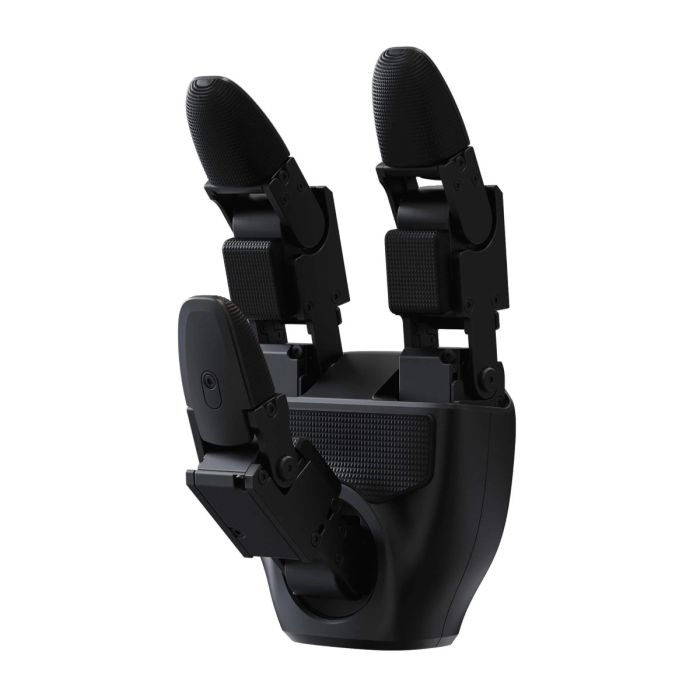
Engineers like to say that a humanoid robot is only as useful as the last joint before the object, and for most manipulation work that joint sits just beyond the wrist. Legs carry the robot to the bench and arms bring it within reach, but the task itself is won or lost in a space no larger than a paperback book. The Unitree G1 Dex3-1 Force Control Three Finger Dexterity Hand is Unitree's answer to that compact problem: seven degrees of freedom, seven micro brushless motors and 33 tactile sensors packed into a housing of 175mm x 88mm x 77mm, designed to give the G1 humanoid robot a hand that can sense contact and moderate its own grip rather than simply close on command.
Robots Middle East supplies the Unitree G1 Dex3-1 Force Control Three Finger Dexterity Hand to research laboratories, universities, integrators and corporate innovation teams across the Middle East. Robots Middle East prepares each quotation, arranges delivery into the region and provides after-sales support, so that teams adding dexterous manipulation to their G1 platform deal with a single, accountable supplier from enquiry to commissioning.
Background
Unitree Robotics and the G1 platform
Unitree Robotics built its reputation on agile legged robots before extending its range into full humanoids. The G1 is the company's compact humanoid platform, aimed at research, education and development work where a full-scale bipedal robot must remain practical to transport, programme and maintain. A humanoid platform of this kind becomes considerably more valuable once it can manipulate objects, and that is the role the Dex3-1 fills: it works with the G1 humanoid robot and enables it to perform various complex actions. Within the wider range, the hand sits in the Hands category alongside other end effectors for Unitree humanoids.
Direct drive and hybrid force control
The engineering choice that defines the Dex3-1 is its transmission. Six of its seven joints are driven directly by micro brushless force control motors, while the seventh uses a micro brushless motor with a gear drive. Direct drive removes most of the gearing between motor and finger, which in general terms makes it easier for the controller to read and regulate the force at the joint itself. Unitree pairs this with force and position hybrid control, and the result is a hand that is sensitive and reliable. Each joint is tracked by a rotor absolute value encoder, and the hand's 33 tactile sensors report contact across a perception range of 10g-2500g.
Technical Specifications
| Specification | Value |
|---|---|
| Version | Dex3-1 |
| Hand type | Three-finger dexterous hand |
| Degrees of freedom | 7 |
| Transmission mechanism | 6 Motors Drive Directly, 1 Motor Drive with Gears |
| Joint drives | 6 micro brushless force control joint direct drives, 1 micro brushless force control joint gear drive |
| Tactile sensors | 33 per hand |
| Number of pressure sensors | 9 (Total of 33 Pressure Sensors) |
| Range of perception | 10g-2500g |
| Control method | Force and position hybrid control |
| Joint encoder | Rotor Absolute Value Encoder |
| Size | 175mm x 88mm x 77mm |
| Working temperature range | -20℃ ~ 60℃ |
| Compatibility | G1 humanoid robot |
Specifications are as published by the manufacturer and are confirmed against the datasheet at quotation.
The manufacturer has not published the grip force, the finger speed, the ingress protection (IP) rating or the box contents; Robots Middle East confirms these at quotation.
Why does a three-finger hand use direct drive?
A conventional robotic gripper is usually built around reduction gearing: a small, fast motor turns a gearbox that multiplies its torque. The approach is robust, but gearing adds friction and backlash, and both obscure what is happening at the fingertip. When a controller must judge how firmly it is holding a delicate item, that obscurity becomes a problem, and engineers compensate with additional sensors or conservative grip settings.
The Dex3-1 takes a different route. By driving six of its seven joints directly, it keeps the motor close to the motion it controls, and its force and position hybrid control can then regulate both where a finger goes and how hard it presses. The single geared joint is the exception in an otherwise direct-drive design. For a research team, the practical implication is a hand whose behaviour is easier to model and tune, which matters when the goal is to study grasping strategies rather than merely to execute them.
The three-finger layout is itself a deliberate compromise. A hand with fewer digits carries fewer motors, less wiring and less mass at the end of the arm, while still allowing opposing contacts for pinch and wrap grasps. Teams that need more biomimetic articulation can compare the Unitree Dex5-S Pro 22-DOF Tactile Dexterous Hand, but for many manipulation experiments the leaner architecture of the Dex3-1 is the more manageable starting point.
What does tactile sensing add to a G1 humanoid?
Vision can locate an object, estimate its shape and plan an approach, yet it says little about friction, compliance or slippage once contact begins. The 33 tactile sensors of the Dex3-1, with a perception range of 10g-2500g, close that gap by giving the controller direct feedback from the surfaces that touch the object. Light contact registers at the lower end of the range, while firmer holds remain measurable towards the upper end.
Combined with hybrid control, that feedback allows a G1 to adjust its grip during a task: easing off when an item is fragile, tightening when it begins to slip, and recording the contact data for later analysis. For laboratories working on learning-based manipulation, tactile streams of this kind are valuable training material in their own right. The rotor absolute value encoders complement the touch data with joint position information, so that each grasp can be described in terms of both geometry and force.
Who is the Unitree G1 Dex3-1 Force Control Three Finger Dexterity Hand for?
The clearest buyer is an organisation that already operates, or is acquiring, a Unitree G1 humanoid robot and wants it to handle objects with measured, sensed contact. University robotics departments are a natural fit, particularly groups studying grasp planning, tactile perception or imitation learning. Corporate research and development teams evaluating humanoids for logistics, retail or light assembly will find the hand useful for proof-of-concept work, where demonstrating careful handling is often what persuades stakeholders.
System integrators building demonstrators for clients across the Gulf and the wider region form a third group, as do science centres and innovation hubs that use humanoids to show visitors how modern robots perceive the world. The working temperature range of -20℃ ~ 60℃ is relevant to buyers planning demonstrations outside climate-controlled laboratories, and environmental exposure is best discussed with Robots Middle East when the project is scoped.
Teams working with the H1-2 humanoid rather than the G1 should consider the Unitree H1-2 Dexterous Hand, and those assembling a complete G1 workstation can browse the Humanoid Accessories range for complementary equipment.
What is the Unitree G1 Dex3-1 Force Control Three Finger Dexterity Hand used for?
- Grasp research: studying pinch, wrap and precision grasps with joint-level force and position data.
- Tactile perception studies: using the sensor array to classify objects by contact rather than by sight alone.
- Robot learning: collecting combined touch and joint data to train manipulation policies for the G1.
- Handling demonstrations: showing a humanoid picking up fragile or irregular items in front of clients or visitors.
- Teaching and coursework: giving students hands-on experience with force control and sensor fusion on a real humanoid.
- Application prototyping: testing humanoid handling concepts for logistics, retail or service settings before wider deployment.
Pricing and Availability
Robots Middle East supplies the Unitree G1 Dex3-1 Force Control Three Finger Dexterity Hand on a quotation basis, so that the offer reflects your existing G1 configuration, the quantity required and any accompanying accessories. Delivery, customs clearance and technical support are arranged together with the quotation. To begin, share your project details and intended application, and a tailored quotation can be requested through the form available on this page.
Frequently Asked Questions
Which robot is the Dex3-1 designed for?
The Dex3-1 works with the G1 humanoid robot and enables it to perform various complex actions. Robots Middle East matches the hand to your specific G1 configuration when preparing the offer.
How many degrees of freedom does the hand have?
The hand has seven degrees of freedom. Six joints use micro brushless force control direct drives and one uses a micro brushless force control gear drive.
How many tactile sensors does it carry?
One hand carries 33 tactile sensors. The pressure sensor count is 9 (Total of 33 Pressure Sensors), with a range of perception of 10g-2500g.
What control method does the Dex3-1 use?
It uses force and position hybrid control, which keeps the hand sensitive and reliable. Joint positions are tracked by rotor absolute value encoders.
What are the dimensions and operating temperatures?
The hand measures 175mm x 88mm x 77mm. Its working temperature range is -20℃ ~ 60℃.
Does the hand use gears?
Only one of its seven joints is geared. The transmission is 6 Motors Drive Directly, 1 Motor Drive with Gears.
Where can I buy the Unitree G1 Dex3-1 Force Control Three Finger Dexterity Hand and what does it cost?
You can buy it from Robots Middle East, which supplies customers across the Middle East. The cost depends on your configuration and requirements, so request a quotation through this page for a tailored offer.
Summary
The decisive moment of most humanoid tasks happens in a space barely larger than a paperback book, and the Unitree G1 Dex3-1 Force Control Three Finger Dexterity Hand is built to make that space count. Seven degrees of freedom, six direct-drive joints, 33 tactile sensors and force and position hybrid control give the G1 a hand that measures contact as it works, while its lean three-finger layout keeps the design manageable for research and demonstration. For organisations across the Middle East ready to move their G1 from walking to working, with Robots Middle East handling quotation, delivery and support, this page is the starting point.
Specifications
General
What's included
Related Products
Out of stock