
Unitree H1-2 Dexterous Hand
In stock
- BRAND:
- UNITREE ROBOTICS
- PART #:
- H1-2 dexterous hand (develop by Unitree)
- ORIGIN:
- China
- AVAILABILITY:
- SUBJECT TO AVAILABILITY
- SKU:
- Unitree-H1-2-Dexterous-Hand
Unitree H1-2 Dexterous Hand
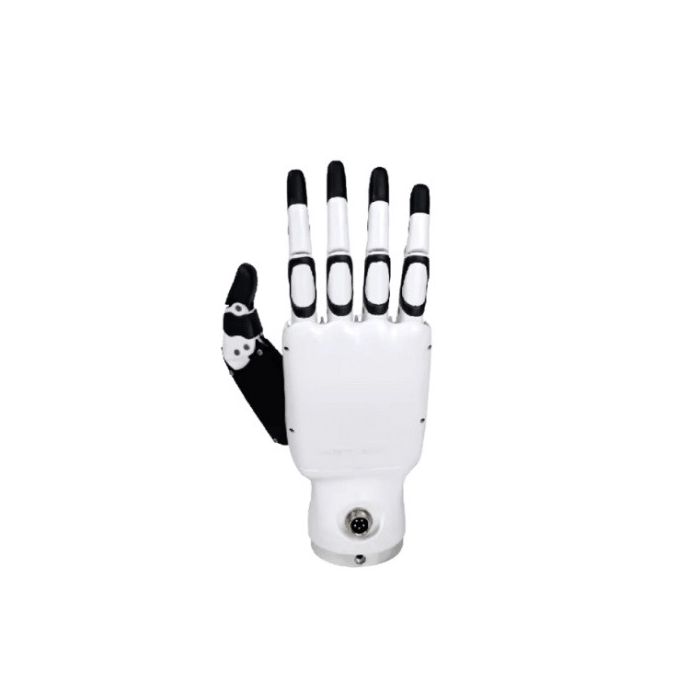
Humanoid specification sheets usually open with height, stride and balance, yet the decision that shapes a research programme is often taken at the wrist. A platform that can stand and walk but cannot handle a tool, a component or a sample remains a demonstration rather than an instrument. The Unitree H1-2 Dexterous Hand closes that gap for the H1-2 humanoid. It is a multi-jointed hand with ≥10 degrees of freedom and haptic array sensors on every finger, so the robot registers contact while it grasps instead of simply closing around an object and hoping for the best.
Robots Middle East sells the Unitree H1-2 Dexterous Hand to universities, research institutes, system integrators and corporate innovation teams throughout the Middle East. We prepare each quotation against the exact H1-2 configuration you already operate or intend to order. We also arrange delivery and customs clearance to your site, and we remain your point of contact for technical support once the hands are installed and in use.
Background
Unitree Robotics and the H series
Unitree Robotics, based in Hangzhou, built its reputation on agile quadruped robots before extending its range into full-size and compact humanoids. The H series is the company's full-size bipedal line, and the H1-2 is the development of the original H1, standing about 178CM tall. Throughout this development Unitree has treated manipulation as a configurable layer rather than a fixed feature. The robot can be equipped with 2 optional hand modules, and for the H1-2 the published options include the Dex5-1 or other ambidextrous hands.
This modular approach matters to buyers. A laboratory can begin with locomotion and whole-body control research and add hands when the programme moves towards manipulation. Alternatively, it can specify hands from the outset where grasping is the core of the work. In either case the hand becomes the component that decides which experiments and applications the humanoid can support.
Touch sensing at the level of each finger
The defining feature of this hand is where its sensing sits. Each finger carries haptic array sensors with >20 sensor contacts per finger, so contact information is distributed along the hand rather than gathered at a single point. Each finger joint is actuated with a maximum output torque of >0.7 Nm, and the hand as a whole offers ≥10 degrees of freedom. Taken together, these figures describe a hand intended for controlled, sensor-informed grasping: the kind of interaction in which the controller adjusts the grip according to what the fingers report, moment by moment, rather than relying on a pre-programmed closing motion.
Technical Specifications
| Specification | Value |
|---|---|
| Degrees of freedom | ≥10 degrees of freedom |
| Hand modules per robot | 2 optional hand modules |
| Finger sensing | Haptic array sensors for each finger |
| Sensor contacts per finger | >20 |
| Maximum output torque of each finger joint | >0.7 Nm |
| Hand options on the H1-2 | Optional Dex5-1 or other ambidextrous hands |
| H1-2 robot height | about 178CM |
Specifications are given as published by the manufacturer and are confirmed against the datasheet at quotation.
Unitree has not published the hand's weight, its dimensions, operating voltage, communication interface, payload per hand, fingertip force, positioning accuracy or the contents of the box; Robots Middle East confirms these details with you at quotation.
Why does touch sensing in every finger matter on a humanoid?
Cameras are the primary sense of most humanoid robots, but they have a well-known blind spot: the moment a hand closes around an object, the fingers themselves hide the point of contact. A grasp guided by vision alone therefore loses much of its information exactly when it becomes most important. Tactile sensing fills that gap. When each finger carries its own haptic array, the controller can detect where an object touches the hand, notice when it begins to slip and moderate the grip before a fragile item is damaged or a heavier one is dropped.
For research teams the benefit extends beyond the individual grasp. Distributed contact data is valuable input for learning-based control, whether a group is training policies through imitation, refining them through reinforcement learning or studying how human demonstrators handle objects. A hand that records contact across every finger turns each trial into a richer dataset, which in turn makes experiments more informative and results easier to analyse. On a full-size humanoid, where the hand works at human scale and among human objects, this kind of feedback is often the difference between a gesture and a dependable manipulation task.
How does this hand fit the H1-2's hand options?
Unitree designs the H1-2 to accept optional hands rather than shipping a single fixed end effector. The platform can carry 2 hand modules, and its published options name the Dex5-1 or other ambidextrous hands. In practice this means a buyer is choosing a manipulation configuration as much as a product: one hand or two, a matched left and right pair, and a hand whose sensing and articulation suit the intended experiments.
Because several hand listings relate to the H1 family, we recommend confirming three points before ordering. First, which hand variant this listing supplies for your robot. Second, whether you require a single hand or a pair. Third, which software and integration support accompanies the hands on your existing H1-2. Robots Middle East checks each of these against your robot's configuration as part of the quotation, so the hardware you receive matches the platform already in your laboratory.
Who is the Unitree H1-2 Dexterous Hand for?
The clearest fit is a research group that already works with the H1-2, or plans to, and needs its humanoid to move from locomotion studies into manipulation. Robotics and artificial intelligence laboratories studying grasp planning, tactile perception and learning from demonstration will find the per-finger sensing especially relevant, as will groups building datasets for embodied AI.
Universities and technical colleges form a second segment. A humanoid with sensing hands gives students a single platform on which to explore mechanics, control and machine learning together, and it makes laboratory courses and final-year projects considerably more tangible. System integrators and corporate innovation teams make up a third group: organisations evaluating whether a full-size humanoid can take on handling, inspection or assembly-related tasks will want hands that report contact, not merely hands that close.
Some buyers will be better served by a neighbouring product. Teams that work with Unitree's compact G1 humanoid rather than the H1-2 should look at the Unitree G1 Dex3-1 Force-Controlled 3-Finger Tactile Dexterous Hand, which is designed for that platform. Those who specifically want the tactile Dex5-1P option for the H1 or H1-2 can review the Unitree Dex5-1P Tactile Hand For H1-H1-2 (Left) (DEX5-HANDL). The full range is gathered in our Hands category, and complementary items for the robot itself are listed under Humanoid Accessories.
What is the Unitree H1-2 Dexterous Hand used for?
- Dexterous manipulation research – studying grasp strategies, in-hand repositioning and multi-finger coordination on a full-size humanoid.
- Tactile data collection – recording contact information from every finger to train and validate learning-based control policies.
- Teleoperation and imitation learning – capturing human demonstrations through the robot's hands and transferring them into autonomous behaviour.
- Human–robot interaction studies – examining safe handovers, gentle contact and shared tasks between people and humanoid robots.
- Industrial task evaluation – testing whether a humanoid can handle parts, operate tools or support assembly steps in a realistic setting.
- Teaching and demonstration – giving students and visitors a working example of sensing, control and artificial intelligence combined in one platform.
Pricing and Availability
Robots Middle East supplies the Unitree H1-2 Dexterous Hand on a quotation basis, because the right configuration depends on your robot, the number of hands required and the support your programme needs. Delivery, customs clearance and technical support are arranged together with your quotation. To begin, please send us your H1-2 configuration and intended application through the quotation request available on this page.
Frequently Asked Questions
How many degrees of freedom does the hand offer?
The Unitree H1-2 Dexterous Hand is a multi-jointed hand with ≥10 degrees of freedom, which allows coordinated movement of the fingers for varied grasps.
What kind of touch sensing does it have?
Each finger carries haptic array sensors, with >20 sensor contacts per finger. This distributes contact information across the whole hand.
How much torque do the finger joints produce?
The maximum output torque of each finger joint is >0.7 Nm. This figure applies to every finger joint individually.
Can the H1-2 be fitted with two hands?
Yes. The robot can be equipped with 2 optional hand modules, so a matched pair can be specified for bimanual work.
Does this hand fit the original H1?
This listing is described for the H1-2. If you operate an original H1, Robots Middle East will check compatibility with your robot before quoting.
What is included in the delivery?
Robots Middle East sets out exactly what is supplied in your quotation, so you know the full scope of the delivery before you place an order.
Where can I buy the Unitree H1-2 Dexterous Hand and what does it cost?
You can buy it from Robots Middle East, which supplies customers across the Middle East. The cost depends on your configuration and support requirements, so please request a quotation and our team will respond with a complete offer.
Summary
A humanoid is judged first by how it stands and walks, but it earns its place in a laboratory by what it can do with its hands. The Unitree H1-2 Dexterous Hand gives the H1-2 that capability: ≥10 degrees of freedom, haptic array sensors on every finger and finger joints rated above 0.7 Nm, mounted as one or two optional modules on a robot of about 178CM. For research groups, universities and integrators across the Middle East, Robots Middle East confirms the configuration, arranges delivery and support, and stays with the project after installation. If your programme is ready to move from walking to working, this page is the starting point.
Specifications
General
What's included
Related Products
Out of stock