
Large Industrial Grade Wheeled Quadruped Robot Dog
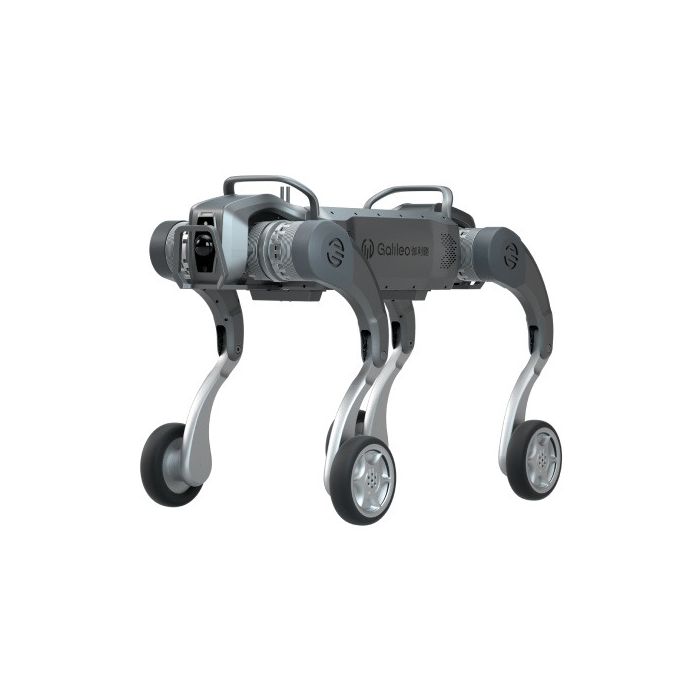
In stock
- BRAND:
- GALILEO
- MODEL:
- S1-W
- ORIGIN:
- China
- Warranty:
- 12 MONTHS
- AVAILABILITY:
- SUBJECT TO AVAILABILITY
- SKU:
- GALILEO-S1-W
Large Industrial Grade Wheeled Quadruped Robot Dog
Consider a robot that can sit almost motionless at a remote site for a year, then wake on a remote command and move at up to 6m/s with a 100kg load on its back. That contrast between long dormancy and sudden heavy work is what sets the Large Industrial Grade Wheeled Quadruped Robot Dog apart. GALILEO built the S1-W for operators who need a machine ready when an inspection round, a supply run or an incident begins, without a technician on site to switch it on.
Robots Middle East sells the GALILEO-S1-W and supplies it to industrial, energy, logistics and public-safety organisations across the Middle East. Robots Middle East prepares every quotation for this robot, arranges its delivery to the customer's site and remains the point of contact for support once the machine is in service.
Background
The GALILEO S1 Series
The S1-W belongs to GALILEO's S1 Series, a heavy-duty, large-scale bionic robot family designed for demanding professional work. The series is designed for four scenarios: industrial inspection, plateau material transportation, inspection with large equipment mounted on the robot, and emergency rescue. Two versions appear in the sources: the S1, a legged quadruped, and the S1-W, its wheeled counterpart. Both share the same battery system, the same load ratings and the same environmental protection, so the choice between them depends on how the robot will move rather than on what it can withstand.
Two computers and an open electrical architecture
Two processors sit at the heart of the S1-W. A domestic ARM low-power, high-performance CPU with 8 cores, 8 threads, 8GB RAM and a 64GB SSD works alongside an X86 low-power, high-performance CPU with 4 cores, 8 threads, 16GB RAM and a 256GB HDD. An architecture of this kind is common in field robotics, where one processor can handle motion control while the other carries perception, mapping or customer software. The robot also offers external power at 48V and 24V, and Ethernet, USB3.0 and RS485 communication interfaces, all of which can be expanded as needed. Customisable payload interfaces allow inspection sensors, transport bins and rescue equipment to be integrated, which makes the S1-W a carrier platform as much as a finished product.
Technical Specifications
| Specification | Value (S1-W) |
|---|---|
| Standing dimensions (L x W x H) | 1200x550x760mm |
| Weight | 128kg |
| Battery capacity | 60Ah(3540Wh, Dual Batteries) |
| Battery type | Lithium Battery |
| Battery rated voltage | 59V |
| Charger input | 100V~240V |
| External power interface | 48V;24V(Expandable as needed) |
| External communication interface | Ethernet; USB3.0; RS485(Interface expandable as needed) |
| Low power mode | ≥365 days, supports remote wake-up |
| Autonomous charging | Supported |
| Movement speed | 0-6m/s(Adjustable) |
| Maximum climbable slope | ≥30° |
| Climbable height | 30cm high consecutive steps, Forward height difference 110cm platform |
| Endurance time | 2.5-4h |
| Continuous walking load | 100kg |
| Maximum standing load | 170kg |
| Onboard computing (CPU) | Domestic ARM low-power high-performance CPU (8 cores 8 threads / 8GB RAM / 64GB SSD) + X86 low-power high-performance CPU (4 cores 8 threads / 16GB RAM / 256GB HDD) |
| WIFI6 dual-band wireless | Supported |
| Protection rating | IP67 |
| Operating environment temperature | -20℃~55℃ |
Specifications are as published by the manufacturer and are confirmed against the datasheet at quotation.
The manufacturer has not published the box contents, the sensor and camera details, the payload mounting options, the charging time or the operating software details; these are confirmed at quotation.
How does the S1-W differ from the legged S1?
The two S1 Series versions share more than they differ. Each carries the same dual lithium battery pack, the same continuous walking and standing load ratings, the same slope capability, the same IP67 protection and the same operating temperature range. The differences lie in posture, mass and pace. The S1-W stands taller and weighs more than the legged S1, it has a higher top speed, and it can climb onto a higher forward platform. The price of that pace is a shorter endurance range per charge.
In practice, the S1-W suits routes where distance and speed matter: long perimeter patrols, extended pipe racks, or supply runs between buildings on a large site. The legged Galileo S1 Large Industrial Grade Quadruped Robot Dog suits deployments where the longest possible working time on one charge outweighs top speed. Since the load ratings are identical, a team does not give up carrying capacity by choosing either version.
What can the S1-W carry and connect?
With a continuous walking load of 100kg and a maximum standing load of 170kg, the S1-W can carry substantial equipment rather than a single camera. The customisable payload interfaces are intended for inspection sensors, transport bins and rescue equipment, and the 48V and 24V external power outputs mean that mounted instruments can draw power from the robot's own battery. Data leaves the payload over Ethernet, USB3.0 or RS485, and dual-band WIFI6 links the robot to the operator's network.
This openness matters for integrators. A gas detector, a thermal imaging head or a sample container can be specified around the robot rather than the other way round. Robots Middle East works out the exact payload arrangement with each customer before the order is placed.
Who is the Large Industrial Grade Wheeled Quadruped Robot Dog for?
The first group of buyers is asset owners in oil, gas, petrochemicals and power generation, who run routine inspection rounds across large facilities. For them, autonomous charging and a low power mode with remote wake-up reduce the need for staff to attend the robot between missions, and the IP67 rating and -20℃~55℃ operating range address dust, water and heat.
The second group is logistics and construction teams moving materials over rough or elevated ground, for whom the 100kg continuous walking load and the ability to climb 30cm consecutive steps are the central figures. The third group is civil defence, fire and rescue services, and teams evaluating robots alongside the wider Emergency Response range, who need a platform able to carry rescue equipment towards an incident. Finally, system integrators and research groups will value the twin-processor architecture and expandable interfaces as a base for their own software and sensors.
Buyers whose missions are long and slow rather than fast and far should compare the legged S1, which offers longer endurance on the same battery.
What is the Large Industrial Grade Wheeled Quadruped Robot Dog used for?
- Industrial inspection: carrying inspection sensors along fixed routes at plants, substations and processing facilities.
- Plateau material transportation: moving supplies and tools over elevated or uneven terrain where vehicles struggle.
- Large-equipment mounted inspection: serving as a powered, connected carrier for heavy inspection instruments.
- Emergency rescue: bringing rescue equipment into hazardous areas ahead of, or alongside, response teams.
- Remote standby duty: waiting in low power mode at unattended sites until woken remotely for a mission.
- Integration and research: hosting custom payloads and software on its ARM and X86 computing platforms.
Pricing and Availability
Robots Middle East supplies the GALILEO-S1-W on a quotation basis, as each order depends on the payload, interfaces and site conditions involved. Delivery, customs clearance and after-sales support are arranged together with the quotation. The quotation request form for the Large Industrial Grade Wheeled Quadruped Robot Dog is available on this page.
Frequently Asked Questions
Is the S1-W protected against dust and water?
Yes. The S1-W carries an IP67 protection rating.
In what temperatures can the robot operate?
The operating environment temperature is -20℃~55℃.
Can the S1-W charge itself?
Yes, autonomous charging is supported, which reduces the need for staff to connect the robot by hand between missions.
How much can it carry?
The continuous walking load is 100kg and the maximum standing load is 170kg.
Which sensors and cameras are included?
The sensor and camera configuration is specified with each order. Robots Middle East sets it out, together with the box contents, in the quotation.
Can our own equipment be integrated?
Customisable payload interfaces allow inspection sensors, transport bins and rescue equipment to be integrated, supported by 48V and 24V power outputs and Ethernet, USB3.0 and RS485 interfaces that can be expanded as needed.
Where can I buy the Large Industrial Grade Wheeled Quadruped Robot Dog and what does it cost?
Robots Middle East sells the S1-W across the Middle East. The cost depends on configuration, payload and delivery, so it is set out in a quotation, which you may request from this page.
Summary
The S1-W combines two qualities rarely found together: the patience to wait at a site for a year in low power mode, and the strength and speed to carry 100kg at pace once it is woken. Its dual-battery system, IP67 protection, open power and data interfaces and twin processors make it a working platform for inspection, transport and rescue, while its wheeled design favours distance and speed over the longer endurance of the legged S1. Robots Middle East quotes, delivers and supports the robot throughout the region, and for any organisation weighing a heavy-duty quadruped for its sites, this page is the starting point.